Ch.20 - Electrochemistry
Brown - Chemistry: The Central Science 14th Edition
Brown14th EditionChemistry: The Central ScienceISBN: 9780134414232당신이 사용하는 게 아니라요?교과서 변경
20장, 문제 34c

(c) Why is it impossible to measure the standard reduction potential of a single half-reaction?

검증된 단계별 안내
1
Standard reduction potentials are measured relative to a reference electrode, typically the standard hydrogen electrode (SHE).
A single half-reaction cannot occur independently; it must be paired with another half-reaction to form a complete redox reaction.
The standard reduction potential of a half-reaction is determined by measuring the voltage of a galvanic cell composed of the half-reaction and the SHE.
Without a complete redox reaction, there is no flow of electrons, and thus no potential difference to measure.
Therefore, it is impossible to measure the standard reduction potential of a single half-reaction in isolation.

비슷한 문제에 대한 검증된 영상 답변:

이 영상 해법은 위 문제에 도움이 된다고 튜터들이 추천한 것입니다.
영상 길이:
40s
도움이 되었나요?

주요 개념

질문에 올바르게 답하기 위해 반드시 이해해야 하는 핵심 개념들은 다음과 같습니다.

Standard Reduction Potential

Standard reduction potential (E°) is a measure of the tendency of a chemical species to gain electrons and be reduced. It is defined under standard conditions (1 M concentration, 1 atm pressure, and 25°C) and is typically measured against a standard reference electrode, such as the standard hydrogen electrode. This potential is crucial for understanding redox reactions and predicting the direction of electron flow.
추천 영상:
가이드 코스
01:10
Standard Reduction Potentials

Half-Reaction

A half-reaction represents either the oxidation or reduction process in a redox reaction, showing the transfer of electrons. Each half-reaction can be written separately, but they cannot exist in isolation when measuring potentials. To determine the standard reduction potential, both half-reactions must be considered together, as they are interdependent in a complete redox process.
추천 영상:
가이드 코스
01:49
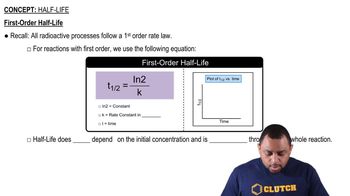
First-Order Half-Life

Reference Electrode

A reference electrode is a stable and well-defined electrode used as a comparison point for measuring the potential of other electrodes. The standard hydrogen electrode (SHE) is the most common reference, with a defined potential of 0 V. Since the potential of a half-reaction is relative, it is impossible to measure the potential of a single half-reaction without referencing it to another half-reaction, making it necessary to use a complete cell setup.
추천 영상:
가이드 코스
04:44
Electron Geometry