
Ch.20 - Electrochemistry
Brown - Chemistry: The Central Science 14th Edition
Brown14th EditionChemistry: The Central ScienceISBN: 9780134414232당신이 사용하는 게 아니라요?교과서 변경
20장, 문제 25d

Complete and balance the following equations, and identify the oxidizing and reducing agents: As2O3(s) + NO3-(aq) → H3AsO4(aq) + N2O3(aq) (acidic solution)

검증된 단계별 안내
1
Step 1: Write the unbalanced equation: \( \text{As}_2\text{O}_3 (s) + \text{NO}_3^- (aq) \rightarrow \text{H}_3\text{AsO}_4 (aq) + \text{N}_2\text{O}_3 (aq) \).
Step 2: Separate the equation into two half-reactions, one for oxidation and one for reduction. Identify the changes in oxidation states for arsenic and nitrogen.
Step 3: Balance each half-reaction for mass and charge. For the oxidation half-reaction, balance arsenic and oxygen atoms, then add \( \text{H}^+ \) ions to balance hydrogen in acidic solution. For the reduction half-reaction, balance nitrogen and oxygen atoms, then add \( \text{H}^+ \) ions.
Step 4: Balance the charges in each half-reaction by adding electrons. Ensure that the number of electrons lost in the oxidation half-reaction equals the number of electrons gained in the reduction half-reaction.
Step 5: Combine the balanced half-reactions, cancel out common species, and identify the oxidizing agent (the species that gets reduced) and the reducing agent (the species that gets oxidized).

비슷한 문제에 대한 검증된 영상 답변:

이 영상 해법은 위 문제에 도움이 된다고 튜터들이 추천한 것입니다.
영상 길이:
7m

주요 개념

질문에 올바르게 답하기 위해 반드시 이해해야 하는 핵심 개념들은 다음과 같습니다.

Redox Reactions

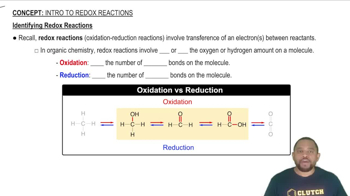
Redox reactions, or oxidation-reduction reactions, involve the transfer of electrons between species. In these reactions, one substance is oxidized (loses electrons) while another is reduced (gains electrons). Understanding the changes in oxidation states of the elements involved is crucial for identifying the oxidizing and reducing agents.
추천 영상:
가이드 코스
03:12
Identifying Redox Reactions

Balancing Chemical Equations

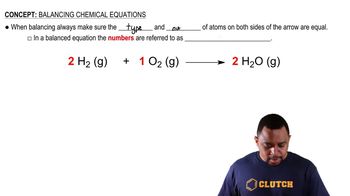
Balancing chemical equations ensures that the number of atoms for each element is the same on both sides of the equation, adhering to the law of conservation of mass. This process often involves adjusting coefficients in front of compounds and may require balancing charges in redox reactions, especially in acidic or basic solutions.
추천 영상:
가이드 코스
01:32
Balancing Chemical Equations

Identifying Oxidizing and Reducing Agents

The oxidizing agent is the species that gets reduced (gains electrons), while the reducing agent is the species that gets oxidized (loses electrons). To identify these agents, one must analyze the changes in oxidation states of the elements in the reaction, determining which species undergoes reduction and which undergoes oxidation.
추천 영상:
가이드 코스
01:01
Oxidizing and Reducing Agents
관련 실천
교과서 질문

Complete and balance the following equations, and identify the oxidizing and reducing agents. (Recall that the O atoms in hydrogen peroxide, H2O2, have an atypical oxidation state.) H2O21aq2 + ClO21aq2 ¡ ClO2-1aq2 + O21g2 (basic solution)

491
views
교과서 질문

Complete and balance the following half-reactions. In each case indicate whether the half-reaction is an oxidation or a reduction. (a) Mo3+(aq) → Mo(s) (acidic solution) (b) H2SO3(aq) → SO42-(aq) (acidic solution) (c) NO3-(aq) → NO(g) (acidic solution) (d) O2(g) → H2O(l) (acidic solution)

504
views
교과서 질문

Complete and balance the following half-reactions. In each case indicate whether the half-reaction is an oxidation or a reduction. (g) Cr(OH)3(s) → CrO42-(aq) (basic solution)

1151
views
교과서 질문

Complete and balance the following equations, and identify the oxidizing and reducing agents: (a) Cr2O72-(aq) + I-(aq) → Cr3+(aq) + IO3-(aq) (acidic solution) (b) MnO4-(aq) + CH3O(1aq) → Mn2+(aq) + HCOOH(aq) (acidic solution) (c) I2(s) + OCl-(aq) → IO3-(aq) + Cl-(aq) (acidic solution)

771
views
교과서 질문

Complete and balance the following equations, and identify the oxidizing and reducing agents: MnO4-(aq) + Br-(aq) → MnO2(s) + BrO3-(aq) (basic solution)

703
views
교과서 질문

Complete and balance the following equations, and identify the oxidizing and reducing agents. (Recall that the O atoms in hydrogen peroxide, H2O2, have an atypical oxidation state.) (a) NO2-(aq) + Cr2O72-(aq) → Cr3+(aq) + NO3-(aq) (acidic solution) (b) S(s) + HNO3(aq) → H2SO3(aq) + N2O(g) (acidic solution) (c) Cr2O72- (aq) + CH3OH(aq) → HCOOH(aq) + Cr3+(aq) (acidic solution) (d) BrO3-(aq) + N2H4(g) → Br-(aq) + N2(g) (acidic solution)

555
views