

Ch.20 - Electrochemistry
Brown - Chemistry: The Central Science 14th Edition
Brown14th EditionChemistry: The Central ScienceISBN: 9780134414232당신이 사용하는 게 아니라요?교과서 변경
20장, 문제 6

Consider the following table of standard electrode potentials for a series of hypothetical reactions in an aqueous solution: reduction half-reaction E °(V) (c) Which substance(s) can oxidize C2+?

검증된 단계별 안내
1
insert step 1> Identify the reduction half-reaction for C^{2+} and note its standard electrode potential, E^\(\circ\).
insert step 2> Understand that a substance can oxidize C^{2+} if it has a higher standard electrode potential than the C^{2+}/C half-reaction.
insert step 3> Review the table of standard electrode potentials provided in the problem.
insert step 4> Compare the E^\(\circ\) values of other substances with the E^\(\circ\) value of the C^{2+}/C half-reaction.
insert step 5> Identify the substances with higher E^\(\circ\) values than C^{2+}/C, as these can oxidize C^{2+}.

비슷한 문제에 대한 검증된 영상 답변:

이 영상 해법은 위 문제에 도움이 된다고 튜터들이 추천한 것입니다.
영상 길이:
2m

주요 개념

질문에 올바르게 답하기 위해 반드시 이해해야 하는 핵심 개념들은 다음과 같습니다.

Standard Electrode Potential

Standard electrode potential (E°) is a measure of the tendency of a chemical species to be reduced, expressed in volts. It indicates how easily a species can gain electrons in a half-reaction. A higher E° value means a greater ability to be reduced, while a lower E° indicates a stronger tendency to oxidize. Understanding these values is crucial for predicting the direction of redox reactions.
추천 영상:
가이드 코스
01:27
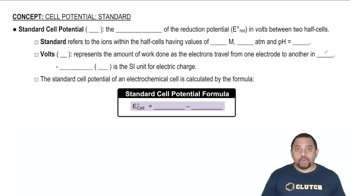
Standard Cell Potential

Oxidizing and Reducing Agents

In redox reactions, an oxidizing agent is a substance that gains electrons and is reduced, while a reducing agent loses electrons and is oxidized. To determine which substances can oxidize C2+, one must identify those with higher standard electrode potentials than C2+. This relationship is essential for predicting which species can facilitate the oxidation of another.
추천 영상:
가이드 코스
01:01
Oxidizing and Reducing Agents

Half-Reaction Method

The half-reaction method involves separating oxidation and reduction processes to analyze redox reactions. Each half-reaction can be assigned a standard electrode potential, allowing for the comparison of different species. By using this method, one can determine the feasibility of reactions and identify which substances can act as oxidizers or reducers based on their respective potentials.
추천 영상:
가이드 코스
01:49
Method 1 of Radioactive Half-Life