
The capacity of batteries such as the typical AA alkaline battery is expressed in units of milliamp-hours (mAh). An AA alkaline battery yields a nominal capacity of 2850 mAh. (b) The starting voltage of a fresh alkaline battery is 1.55 V. The voltage decreases during discharge and is 0.80 V when the battery has delivered its rated capacity. If we assume that the voltage declines linearly as current is withdrawn, estimate the total maximum electrical work the battery could perform during discharge.
Ch.20 - Electrochemistry
20장, 문제 106c
Disulfides are compounds that have S ¬ S bonds, like peroxides have O ¬ O bonds. Thiols are organic compounds that have the general formula R ¬ SH, where R is a generic hydrocarbon. The SH- ion is the sulfur counterpart of hydroxide, OH-. Two thiols can react to make a disulfide, R ¬ S ¬ S ¬ R. (c) If you react two thiols to make a disulfide, are you oxidizing or reducing the thiols?
검증된 단계별 안내1
insert step 1> Identify the functional groups involved in the reaction: thiols (R-SH) and disulfides (R-S-S-R).
insert step 2> Understand the concept of oxidation and reduction: Oxidation involves the loss of electrons, while reduction involves the gain of electrons.
insert step 3> Analyze the change in oxidation state of sulfur: In thiols (R-SH), sulfur is in a lower oxidation state compared to disulfides (R-S-S-R).
insert step 4> Determine the electron transfer: When two thiols form a disulfide, each sulfur atom loses an electron, indicating oxidation.
insert step 5> Conclude that the reaction of two thiols to form a disulfide involves the oxidation of the thiols.

비슷한 문제에 대한 검증된 영상 답변:
이 영상 해법은 위 문제에 도움이 된다고 튜터들이 추천한 것입니다.
영상 길이:
1m주요 개념
질문에 올바르게 답하기 위해 반드시 이해해야 하는 핵심 개념들은 다음과 같습니다.
Oxidation and Reduction
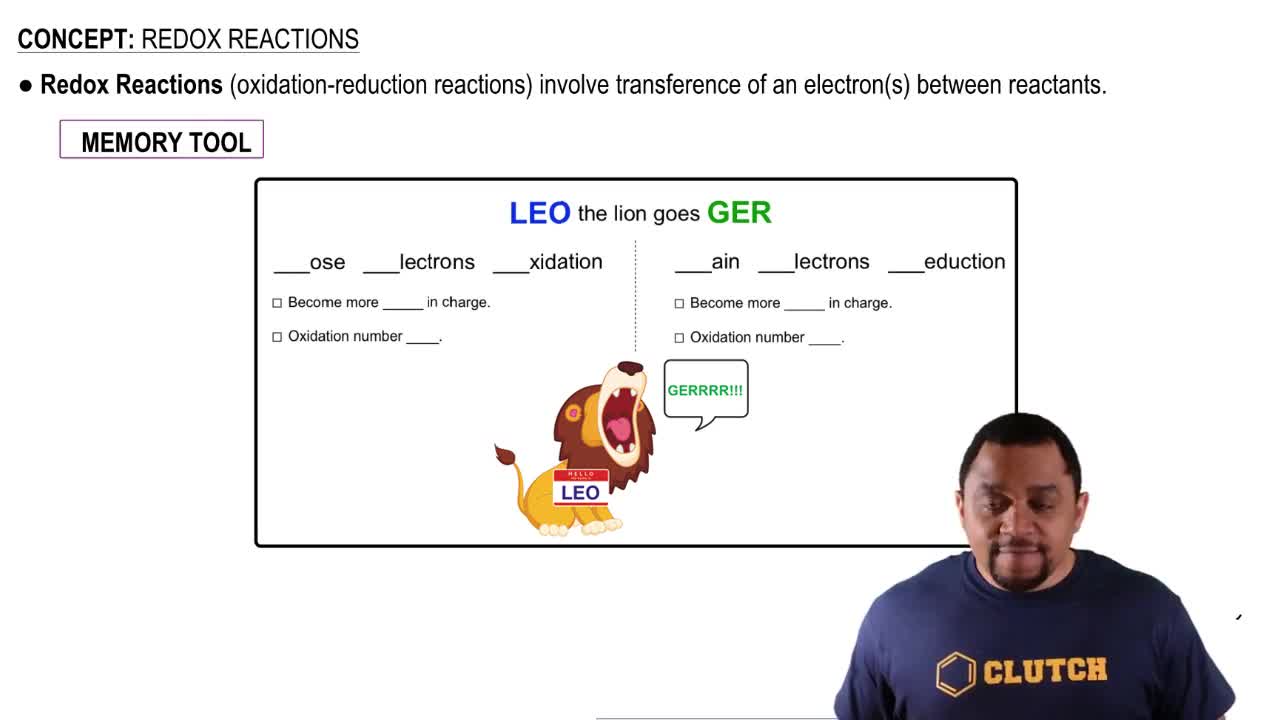
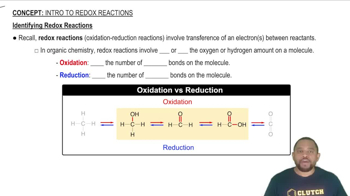
Oxidation and reduction are chemical processes that involve the transfer of electrons between substances. Oxidation refers to the loss of electrons, while reduction involves the gain of electrons. In organic chemistry, oxidation often results in an increase in the number of bonds to oxygen or a decrease in bonds to hydrogen, while reduction typically has the opposite effect.
추천 영상:
가이드 코스
Oxidation and Reduction Reactions
Thiols and Disulfides
Thiols are organic compounds characterized by the presence of a sulfhydryl group (-SH), which can participate in redox reactions. When two thiols react, they can form a disulfide bond (R-S-S-R), which involves the coupling of two sulfur atoms. This transformation is significant in biochemistry, as disulfide bonds play a crucial role in stabilizing protein structures.
추천 영상:
가이드 코스
Non-Carbonyl Functional Groups
Redox Reaction in Thiol to Disulfide Conversion
The conversion of two thiols into a disulfide bond is classified as an oxidation reaction. During this process, each thiol loses a hydrogen atom (as H+ and e-), resulting in the formation of the disulfide bond. Thus, the thiols are oxidized, while the disulfide formed is a more oxidized state of sulfur compared to the thiols.
추천 영상:
가이드 코스
Identifying Redox Reactions
관련 실천
교과서 질문
9696
views
교과서 질문
Disulfides are compounds that have S ¬ S bonds, like peroxides have O ¬ O bonds. Thiols are organic compounds that have the general formula R ¬ SH, where R is a generic hydrocarbon. The SH- ion is the sulfur counterpart of hydroxide, OH-. Two thiols can react to make a disulfide, R ¬ S ¬ S ¬ R. (b) What is the oxidation state of sulfur in a disulfide?
683
views
교과서 질문
Calculate the number of kilowatt-hours of electricity required to produce 1.0 * 103 kg (1 metric ton) of aluminum by electrolysis of Al3+ if the applied voltage is 4.50 V and the process is 45% efficient.
980
views
