Ch.20 - Electrochemistry
Brown - Chemistry: The Central Science 14th Edition
Brown14th EditionChemistry: The Central ScienceISBN: 9780134414232당신이 사용하는 게 아니라요?교과서 변경
20장, 문제 52b

For each of the following reactions, write a balanced equation, calculate the standard emf, calculate ∆G° at 298 K, and calculate the equilibrium constant K at 298 K. (b) In acidic solution, copper(I) ion is oxidized to copper(II) ion by nitrate ion.

검증된 단계별 안내
1
Write the unbalanced chemical equation for the reaction: Cu^+ + NO_3^- -> Cu^{2+} + NO_2
Balance the chemical equation by ensuring the number of atoms and charges are equal on both sides. Consider the acidic solution, which allows you to add H^+ and H_2O as needed.
Use the standard reduction potentials from a table to find the half-reactions and their standard potentials. Calculate the standard emf (E°) for the reaction using E° = E°(cathode) - E°(anode).
Calculate the standard Gibbs free energy change (∆G°) using the formula ∆G° = -nFE°, where n is the number of moles of electrons transferred and F is the Faraday constant (96485 C/mol).
Calculate the equilibrium constant (K) at 298 K using the relationship ∆G° = -RTlnK, where R is the universal gas constant (8.314 J/mol·K) and T is the temperature in Kelvin.

비슷한 문제에 대한 검증된 영상 답변:

이 영상 해법은 위 문제에 도움이 된다고 튜터들이 추천한 것입니다.
영상 길이:
10m

주요 개념

질문에 올바르게 답하기 위해 반드시 이해해야 하는 핵심 개념들은 다음과 같습니다.

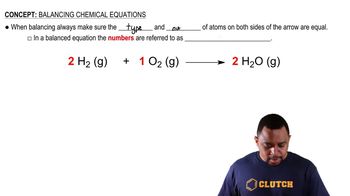
Balancing Chemical Equations

Balancing chemical equations involves ensuring that the number of atoms for each element is the same on both the reactant and product sides. This is crucial for accurately representing the conservation of mass in a chemical reaction. In the context of the given reaction, it requires identifying the oxidation states of copper and nitrate ions and adjusting coefficients to achieve balance.
추천 영상:
가이드 코스
01:32
Balancing Chemical Equations

Standard Electrode Potential (emf)

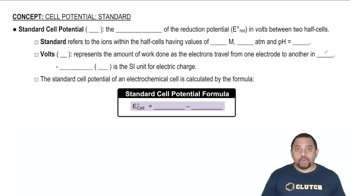
The standard electrode potential (emf) is a measure of the tendency of a chemical species to be reduced, expressed in volts. It is determined under standard conditions (1 M concentration, 1 atm pressure, and 25°C). Calculating the standard emf for the reaction involves using standard reduction potentials from tables and applying the Nernst equation to find the overall cell potential.
추천 영상:
가이드 코스
01:27
Standard Cell Potential

Gibbs Free Energy and Equilibrium Constant

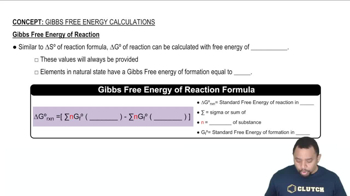
Gibbs free energy (∆G°) is a thermodynamic quantity that indicates the spontaneity of a reaction at constant temperature and pressure. The relationship between ∆G° and the equilibrium constant (K) is given by the equation ∆G° = -RT ln(K), where R is the gas constant and T is the temperature in Kelvin. This relationship allows for the calculation of K from ∆G° and vice versa, providing insight into the position of equilibrium for the reaction.
추천 영상:
가이드 코스
01:51
Gibbs Free Energy of Reactions