
Predict whether the following reactions will be spontaneous in acidic solution under standard conditions: (a) oxidation of Sn to Sn2+ by I2 (to form I-), (b) reduction of Ni2+ to Ni by I- (to form I2), (c) reduction of Ce4+ to Ce3+ by H2O2, (d) reduction of Cu2+ to Cu by Sn2+ (to form Sn4+).
Ch.20 - Electrochemistry
20장, 문제 100c
Gold exists in two common positive oxidation states, +1 and +3. The standard reduction potentials for these oxidation states are Au+1aq2 + e- ¡ Au1s2 Ered ° = +1.69 V Au3+1aq2 + 3 e- ¡ Au1s2 Ered ° = +1.50 V (c) Miners obtain gold by soaking gold-containing ores in an aqueous solution of sodium cyanide. A very soluble complex ion of gold forms in the aqueous solution because of the redox reaction 4 Au1s2 + 8 NaCN1aq2 + 2 H2O1l2 + O21g2 ¡ 4 Na3Au1CN2241aq2 + 4 NaOH1aq2 What is being oxidized, and what is being reduced in this reaction?
검증된 단계별 안내1
Identify the oxidation states of gold in the reactants and products. In the reactants, gold (Au) is in its elemental form, which has an oxidation state of 0. In the products, gold is part of the complex ion Na3Au(CN)4, where it typically has an oxidation state of +1.
Determine the change in oxidation state for gold. Gold goes from an oxidation state of 0 in the reactants to +1 in the products, indicating that gold is being oxidized.
Identify the other elements involved in the reaction. Oxygen (O2) is present in the reactants and is typically in the 0 oxidation state. In the products, it is part of NaOH, where it has an oxidation state of -2.
Determine the change in oxidation state for oxygen. Oxygen goes from an oxidation state of 0 in O2 to -2 in NaOH, indicating that oxygen is being reduced.
Conclude that in this redox reaction, gold (Au) is being oxidized, and oxygen (O2) is being reduced.

비슷한 문제에 대한 검증된 영상 답변:
이 영상 해법은 위 문제에 도움이 된다고 튜터들이 추천한 것입니다.
영상 길이:
5m주요 개념
질문에 올바르게 답하기 위해 반드시 이해해야 하는 핵심 개념들은 다음과 같습니다.
Oxidation and Reduction
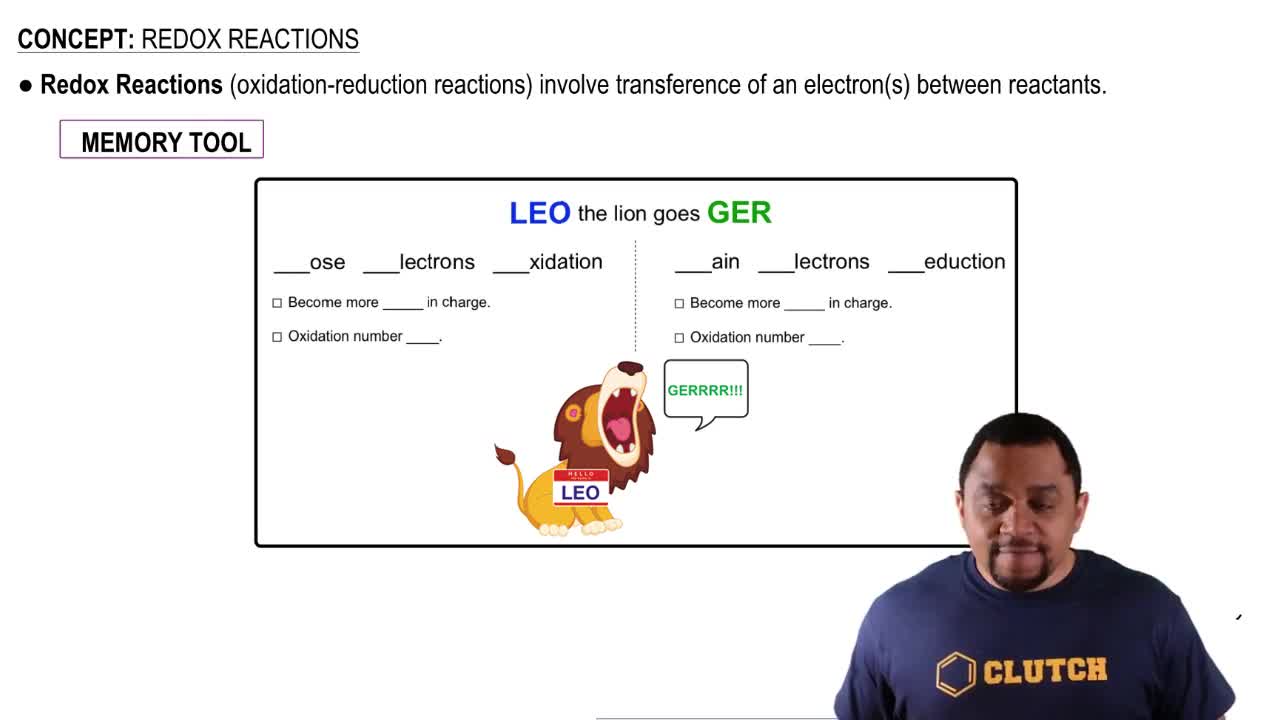
Oxidation and reduction are chemical processes that involve the transfer of electrons between species. Oxidation refers to the loss of electrons, resulting in an increase in oxidation state, while reduction involves the gain of electrons, leading to a decrease in oxidation state. In redox reactions, one species is oxidized and another is reduced, which is essential for understanding the overall reaction.
추천 영상:
가이드 코스
Oxidation and Reduction Reactions
Standard Reduction Potentials
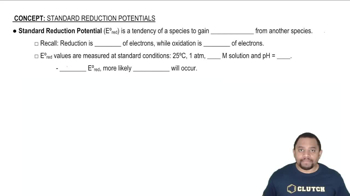
Standard reduction potentials (E°) are measures of the tendency of a chemical species to be reduced, expressed in volts. A higher E° value indicates a greater likelihood of reduction occurring. In the context of the given question, comparing the E° values of Au+1 and Au3+ helps determine which species is more likely to be reduced during the reaction, guiding the identification of oxidized and reduced components.
추천 영상:
가이드 코스
Standard Reduction Potentials
Complex Ion Formation
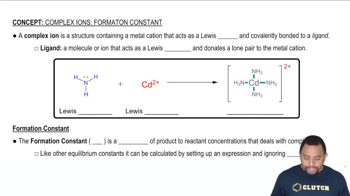
Complex ions are formed when metal ions coordinate with ligands, which are molecules or ions that can donate electron pairs. In the reaction involving gold and sodium cyanide, the formation of the complex ion Na3Au(CN)2 illustrates how gold ions interact with cyanide ligands. Understanding this concept is crucial for analyzing the overall redox process and the stability of the resulting complex in solution.
추천 영상:
가이드 코스
Complex Ions and Formation Constant
관련 실천
교과서 질문
1161
views
교과서 질문
A voltaic cell is constructed that uses the following half-cell reactions:
Cu+(aq) + e- → Cu(s)
I2(s) + 2 e- → 2 I-(aq)
The cell is operated at 298 K with [Cu+] = 0.25 M and [I-] = 0.035 M.
(a) Determine E for the cell at these concentrations.
2756
views
1
rank
교과서 질문
A disproportionation reaction is an oxidation–reduction reaction in which the same substance is oxidized and reduced. Complete and balance the following disproportionation reactions:
(b) MnO42-(aq) → MnO4-(aq) + MnO2(s) (acidic solution)
1228
views
