
Ch.20 - Electrochemistry
Brown - Chemistry: The Central Science 14th Edition
Brown14th EditionChemistry: The Central ScienceISBN: 9780134414232당신이 사용하는 게 아니라요?교과서 변경
20장, 문제 112

In a galvanic cell, the cathode is an Ag+ | 1.00 M | Ag(s) half-cell. The anode is a standard hydrogen electrode immersed in a buffer solution containing 0.10 M benzoic acid (C6H5COOH) and 0.050 M sodium benzoate (C6H5COO-Na+). The measured cell voltage is 1.030 V. What is the pKa of benzoic acid?

검증된 단계별 안내
1
Identify the half-reactions for the galvanic cell. The cathode reaction is Ag+ + e- -> Ag(s), and the anode reaction is the standard hydrogen electrode (SHE), which is 2H+ + 2e- -> H2(g).
Use the Nernst equation to relate the cell potential to the concentrations of the reactants and products. The Nernst equation is E_cell = E°_cell - (RT/nF) * ln(Q), where Q is the reaction quotient.
Calculate the standard cell potential, E°_cell, using standard reduction potentials: E°_cell = E°_cathode - E°_anode. For Ag+/Ag, E°_cathode = +0.80 V, and for SHE, E°_anode = 0.00 V.
Determine the reaction quotient, Q, for the cell. Since the anode involves a buffer solution, use the Henderson-Hasselbalch equation: pH = pKa + log([A-]/[HA]), where [A-] is the concentration of the benzoate ion and [HA] is the concentration of benzoic acid.
Rearrange the Nernst equation to solve for pKa. Substitute the known values (E_cell, E°_cell, concentrations) into the Nernst equation and the Henderson-Hasselbalch equation to find pKa.

주요 개념

질문에 올바르게 답하기 위해 반드시 이해해야 하는 핵심 개념들은 다음과 같습니다.

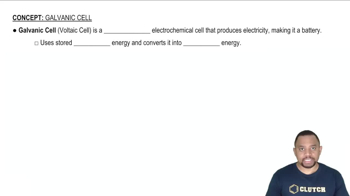
Galvanic Cell

A galvanic cell is an electrochemical cell that converts chemical energy into electrical energy through spontaneous redox reactions. It consists of two half-cells: an anode where oxidation occurs and a cathode where reduction takes place. The flow of electrons from the anode to the cathode generates an electric current, and the cell voltage can be measured to determine the driving force of the reaction.
추천 영상:
가이드 코스
01:08
The Galvanic Cell

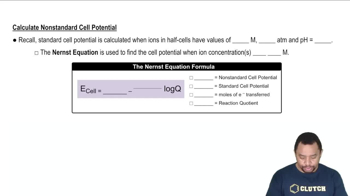
Nernst Equation

The Nernst equation relates the cell potential to the concentrations of the reactants and products in a redox reaction. It is expressed as E = E° - (RT/nF) ln(Q), where E is the cell potential, E° is the standard cell potential, R is the gas constant, T is the temperature in Kelvin, n is the number of moles of electrons transferred, F is Faraday's constant, and Q is the reaction quotient. This equation is crucial for calculating the effect of concentration on cell voltage.
추천 영상:
가이드 코스
01:17
The Nernst Equation

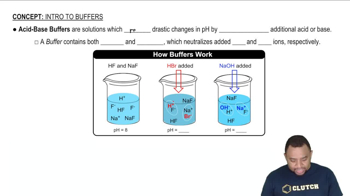
pKa and Buffer Solutions

The pKa is a measure of the strength of an acid in solution, defined as the negative logarithm of its acid dissociation constant (Ka). In buffer solutions, which resist changes in pH, the pKa indicates the pH at which the concentrations of the acid and its conjugate base are equal. For benzoic acid and sodium benzoate, the pKa can be determined using the Henderson-Hasselbalch equation, which relates pH, pKa, and the ratio of the concentrations of the acid and its conjugate base.
추천 영상:
가이드 코스
03:02
Buffer Solutions
관련 실천
교과서 질문

Aqueous solutions of ammonia (NH3) and bleach (active ingredient NaOCl) are sold as cleaning fluids, but bottles of both of them warn: 'Never mix ammonia and bleach, as toxic gases may be produced.' One of the toxic gases that can be produced is chloroamine, NH2Cl. (a) What is the oxidation number of chlorine in bleach? (active ingredient NaOCl) are sold as cleaning fluids, but bottles of both of them warn: “Never mix ammonia and bleach, as toxic gases may be produced.” One of the toxic gases that can be produced is chloroamine, NH2Cl. (b) What is the oxidation number of chlorine in chloramine? (d) Another toxic gas that can be produced is nitrogen trichloride, NCl3. What is the oxidation number of N in nitrogen trichloride?

378
views
교과서 질문

Aqueous solutions of ammonia 1NH32 and bleach (active ingredient NaOCl) are sold as cleaning fluids, but bottles of both of them warn: 'Never mix ammonia and bleach, as toxic gases may be produced.' One of the toxic gases that can be produced is chloroamine, NH2Cl. (e) Is N oxidized, reduced, or neither, upon the conversion of ammonia to nitrogen trichloride?

347
views
교과서 질문

Calculate the number of kilowatt-hours of electricity required to produce 1.0 * 103 kg (1 metric ton) of aluminum by electrolysis of Al3+ if the applied voltage is 4.50 V and the process is 45% efficient.

980
views
교과서 질문

The Haber process is the principal industrial route for converting nitrogen into ammonia: N2(g) + 3 H2(g) → 2 NH3(g) (b) Using the thermodynamic data in Appendix C, calculate the equilibrium constant for the process at room temperature.

717
views