
In some applications nickel–cadmium batteries have been replaced by nickel–zinc batteries. The overall cell reaction for this relatively new battery is: 2 H2O(l) + 2 NiO(OH)(s) + Zn(s) → 2 Ni(OH)2(s) + Zn(OH)2(s) (c) A single nickel–cadmium cell has a voltage of 1.30 V. Based on the difference in the standard reduction potentials of Cd2+ and Zn2+, what voltage would you estimate a nickel–zinc battery will produce? (d) Would you expect the specific energy density of a nickel–zinc battery to be higher or lower than that of a nickel–cadmium battery?
Ch.20 - Electrochemistry
20장, 문제 78b
In some applications nickel–cadmium batteries have been replaced by nickel–zinc batteries. The overall cell reaction for this relatively new battery is: 2 H2O(l) + 2 NiO(OH)(s) + Zn(s) → 2 Ni(OH)2(s) + Zn(OH)2(s) (b) What is the anode half-reaction?
검증된 단계별 안내1
Identify the reactants and products in the overall cell reaction to determine the changes occurring at each electrode.
Recognize that the anode is where oxidation occurs in a battery. Oxidation involves the loss of electrons.
Examine the overall reaction to find which reactant loses electrons. In this case, zinc (Zn) starts as a solid and ends up in a compound, indicating it likely undergoes oxidation.
Write the oxidation half-reaction for zinc. Start with the elemental form of zinc and show its transformation into its oxidized form, incorporating the appropriate number of electrons to balance the reaction.
Balance the half-reaction for mass and charge, ensuring the number of atoms and the electrical charges are equal on both sides of the equation.

비슷한 문제에 대한 검증된 영상 답변:
이 영상 해법은 위 문제에 도움이 된다고 튜터들이 추천한 것입니다.
영상 길이:
8m주요 개념
질문에 올바르게 답하기 위해 반드시 이해해야 하는 핵심 개념들은 다음과 같습니다.
Half-Reactions
Half-reactions are the individual reactions that occur at the anode and cathode in an electrochemical cell. They represent the oxidation and reduction processes separately. In the context of batteries, the anode half-reaction involves the loss of electrons, while the cathode half-reaction involves the gain of electrons. Understanding half-reactions is crucial for analyzing the overall cell reaction.
추천 영상:
가이드 코스
First-Order Half-Life
Oxidation and Reduction
Oxidation is the process where a substance loses electrons, while reduction is the gain of electrons. In electrochemical cells, the anode is where oxidation occurs, and the cathode is where reduction takes place. Identifying which species is oxidized and which is reduced helps in determining the half-reactions and understanding the flow of electrons in the circuit.
추천 영상:
가이드 코스
Oxidation and Reduction Reactions
Electrochemical Cells
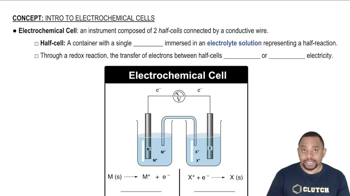
Electrochemical cells convert chemical energy into electrical energy through redox reactions. They consist of two electrodes (anode and cathode) and an electrolyte. The flow of electrons from the anode to the cathode generates electric current. Knowing the structure and function of electrochemical cells is essential for analyzing battery reactions and their applications.
추천 영상:
가이드 코스
Electrochemical Cells
관련 실천
교과서 질문
597
views
교과서 질문
Li-ion batteries used in automobiles typically use a LiMn2O4 cathode in place of the LiCoO2 cathode found in most Li-ion batteries. (a) Calculate the mass percent lithium in each electrode material.
713
views
교과서 질문
Heart pacemakers are often powered by lithium–silver chromate 'button' batteries. The overall cell reaction is 2 Li(s) + Ag2CrO4(s) → Li2CrO4(s) + 2 Ag(s) (b) Choose the two half-reactions from Appendix E that most closely approximate the reactions that occur in the battery. What standard emf would be generated by a voltaic cell based on these half-reactions?
840
views
