
교과서 질문
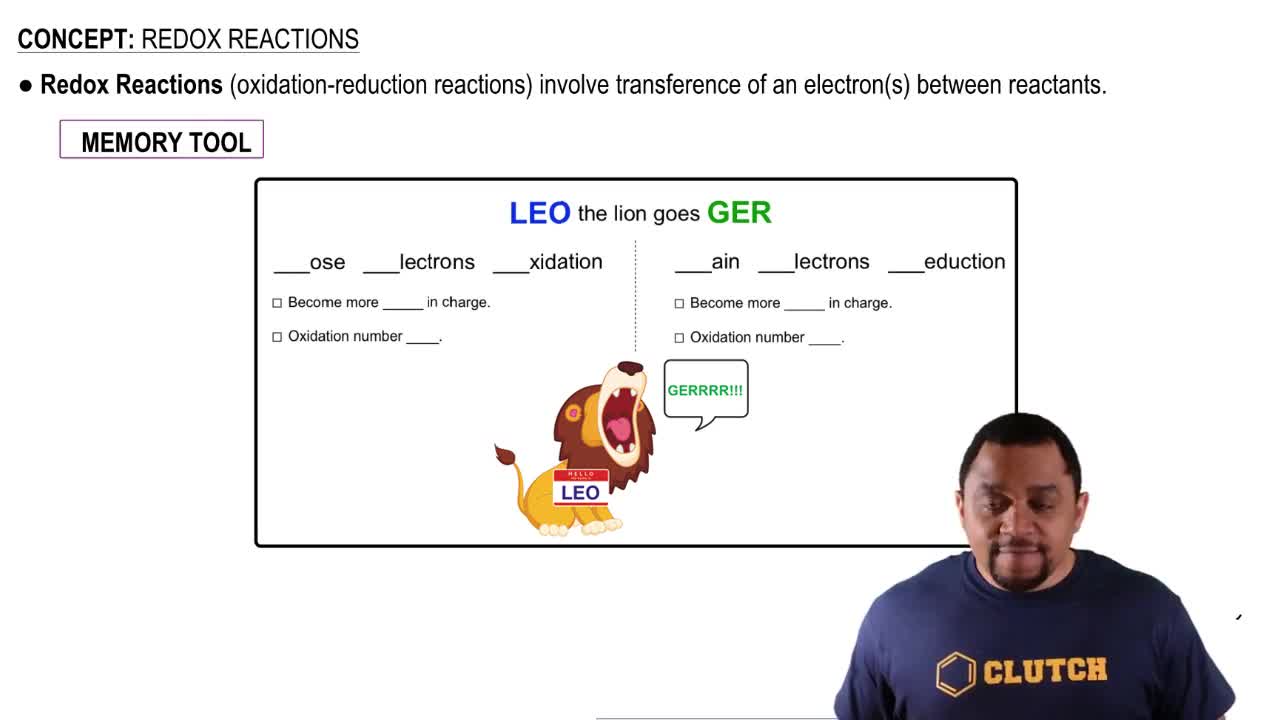
Indicate whether each of the following statements is true or false: (a) If something is reduced, it is formally losing electrons. (b) A reducing agent gets oxidized as it reacts.

 검증된 단계별 안내
 01:53
01:53
 01:01
01:01 02:24
02:24Indicate whether each of the following statements is true or false: (a) If something is reduced, it is formally losing electrons. (b) A reducing agent gets oxidized as it reacts.
Indicate whether each of the following statements is true or false: (c) If there are no changes in the oxidation state of the reactants or products of a particular reaction, that reaction is not a redox reaction.
Indicate whether the following balanced equations involve oxidation–reduction. If they do, identify the elements that undergo changes in oxidation number. (a) PBr3(l) + 3 H2O(l) → H3PO3(aq) + 3 HBr(aq)
Indicate whether each of the following statements is true or false: (b) For the reaction Fe3+(aq) + Co2+(aq) → Fe2+(aq) + Co3+(aq), Fe3+(aq) is the reducing agent and Co2+(aq) is the oxidizing agent.
For each of the following balanced oxidation–reduction reactions, (i) identify the oxidation numbers for all the elements in the reactants and products and (ii) state the total number of electrons transferred in each reaction. (a) I2O5(s) + 5 CO(g) → I2(s) + 5 CO2(g) (b) 2 Hg2+(aq) + N2H4(aq) → 2 Hg(l) + N2(g) + 4 H+(aq) (c) 3 H2S(aq) + 2 H+(aq) + 2 NO3-(aq) → 3 S(s) + 2 NO(g) + 4 H2O(l)
For each of the following balanced oxidation–reduction reactions, (i) identify the oxidation numbers for all the elements in the reactants and products and (ii) state the total number of electrons transferred in each reaction. (a) 2 MnO4-(aq) + 3 S2-(aq + 4 H2O(l) → 3 S(s) + 2 MnO2(s) + 8 OH-(aq) (b) 4 H2O2(aq) + Cl2O7(g) + 2 OH-(aq) → 2 ClO2-(aq) + 5 H2O(l) + 4 O2(g) (c) Ba2+(aq) + 2 OH-(aq) + H2O2(aq) + 2 ClO2(aq) → Ba(ClO2)2(s) + 2 H2O(l) + O2(g)