
Ch.20 - Electrochemistry
Brown - Chemistry: The Central Science 14th Edition
Brown14th EditionChemistry: The Central ScienceISBN: 9780134414232당신이 사용하는 게 아니라요?교과서 변경
20장, 문제 28

Indicate whether each statement is true or false: (a) The anode is the electrode at which oxidation takes place. (b) A voltaic cell always has a positive emf.

검증된 단계별 안내
1
Step 1: Understand the concept of anode and cathode in electrochemical cells. The anode is the electrode where oxidation occurs, and the cathode is where reduction takes place. This is a fundamental principle in electrochemistry.
Step 2: Evaluate statement (a). Recall that oxidation involves the loss of electrons, and this process occurs at the anode. Therefore, statement (a) is true.
Step 3: Understand the concept of electromotive force (emf) in voltaic cells. A voltaic cell, also known as a galvanic cell, generates electrical energy from spontaneous chemical reactions. The emf is the potential difference between the two electrodes.
Step 4: Evaluate statement (b). In a voltaic cell, the chemical reaction is spontaneous, which means it has a positive emf. This is because the cell is designed to produce energy, not consume it.
Step 5: Conclude the evaluation by confirming that both statements are true based on the principles of electrochemistry and the nature of voltaic cells.

주요 개념

질문에 올바르게 답하기 위해 반드시 이해해야 하는 핵심 개념들은 다음과 같습니다.

Electrodes in Electrochemical Cells

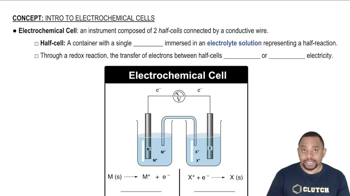
In electrochemical cells, there are two electrodes: the anode and the cathode. The anode is where oxidation occurs, meaning it is the site where electrons are lost by a substance. Conversely, the cathode is where reduction takes place, involving the gain of electrons. Understanding the roles of these electrodes is crucial for analyzing electrochemical reactions.
추천 영상:
가이드 코스
02:46
Electrochemical Cells

Voltaic Cells and Electromotive Force (emf)

A voltaic cell, also known as a galvanic cell, generates electrical energy from spontaneous chemical reactions. The electromotive force (emf) of a voltaic cell is the maximum potential difference between its electrodes when no current is flowing. A positive emf indicates that the cell can perform work, making it essential to recognize that a functioning voltaic cell should always have a positive emf.
추천 영상:
가이드 코스
00:45
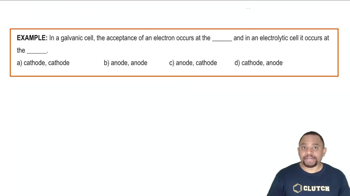
Electrolytic Cell Example

True/False Statements in Chemistry

In chemistry, evaluating statements as true or false often requires a clear understanding of fundamental principles. This involves applying knowledge of chemical reactions, cell components, and their functions. Accurately determining the truth of a statement hinges on recognizing established scientific facts and definitions, which is vital for effective problem-solving in chemistry.
추천 영상:
가이드 코스
01:29
Introduction to Organic Chemistry Example