Ch.20 - Electrochemistry
Brown - Chemistry: The Central Science 14th Edition
Brown14th EditionChemistry: The Central ScienceISBN: 9780134414232당신이 사용하는 게 아니라요?교과서 변경
20장, 문제 3c

The diagram that follows represents a molecular view of a process occurring at an electrode in a voltaic cell.
Diagram showing larger spheres at an electrode and smaller spheres in solution in a voltaic cell.
(c) Why are the atoms in the electrode represented by larger spheres than those in the solution? [Section 20.3]

검증된 단계별 안내
1
Step 1: Identify the components in the diagram. The larger spheres represent atoms in the electrode, while the smaller spheres represent ions in the solution.
Step 2: Understand the context of a voltaic cell. In a voltaic cell, oxidation and reduction reactions occur at the electrodes, leading to the transfer of electrons and ions.
Step 3: Recognize that the larger spheres in the electrode are atoms in their metallic form, which are typically larger due to the presence of a full set of electrons and a neutral charge.
Step 4: Note that the smaller spheres in the solution are ions, which are smaller because they have lost or gained electrons, resulting in a change in size due to the ionic charge and the loss of electron cloud.
Step 5: Conclude that the difference in size between the atoms in the electrode and the ions in the solution is due to the difference in their physical states and charges, with neutral atoms being larger and charged ions being smaller.

비슷한 문제에 대한 검증된 영상 답변:

이 영상 해법은 위 문제에 도움이 된다고 튜터들이 추천한 것입니다.
영상 길이:
5m
도움이 되었나요?

주요 개념

질문에 올바르게 답하기 위해 반드시 이해해야 하는 핵심 개념들은 다음과 같습니다.

Atomic Size and Representation

In molecular diagrams, the size of spheres often represents the relative size of atoms or ions. Larger spheres typically indicate atoms that are part of a solid structure, such as those in an electrode, while smaller spheres represent ions in solution. This visual distinction helps convey the difference in density and arrangement between solid and liquid phases.
추천 영상:

Electrode Function in Voltaic Cells

In a voltaic cell, electrodes serve as sites for oxidation and reduction reactions. The electrode is where electrons are transferred, and the larger spheres represent the solid metal atoms that facilitate this process. Understanding the role of electrodes is crucial for grasping how voltaic cells generate electrical energy through chemical reactions.
추천 영상:
가이드 코스
06:36
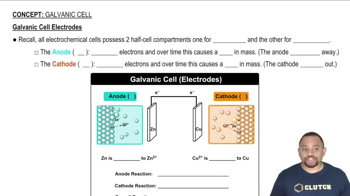
Galvanic Cell Electrodes

Phase Differences in Matter

The concept of phases in matter—solid, liquid, and gas—explains the differences in atomic arrangement and behavior. In solids, atoms are closely packed in a fixed structure, while in liquids, they are more dispersed and mobile. This distinction is essential for understanding why the electrode atoms appear larger and more organized compared to the smaller, more dynamic ions in solution.
추천 영상:
가이드 코스
03:19
States of Matter of Phase Diagrams