Ch.20 - Electrochemistry
Brown - Chemistry: The Central Science 14th Edition
Brown14th EditionChemistry: The Central ScienceISBN: 9780134414232당신이 사용하는 게 아니라요?교과서 변경
20장, 문제 39

The standard reduction potentials of the following halfreactions are given in Appendix E:
Ag+(aq) + e- → Ag(s)
Cu2+(aq) + 2 e- → Cu(s)
Ni2+(aq) + 2 e- → Ni(s)
Cr3+(aq) + 3 e- → Cr(s)
(a) Determine which combination of these half-cell reactions leads to the cell reaction with the largest positive cell potential and calculate the value.
(b) Determine which combination of these half-cell reactions leads to the cell reaction with the smallest positive cell potential and calculate the value.

검증된 단계별 안내
1
Identify the standard reduction potentials for each half-reaction from Appendix E.
Write the half-reactions with their respective standard reduction potentials: \( \text{Ag}^+ + e^- \rightarrow \text{Ag} \), \( \text{Cu}^{2+} + 2e^- \rightarrow \text{Cu} \), \( \text{Ni}^{2+} + 2e^- \rightarrow \text{Ni} \), \( \text{Cr}^{3+} + 3e^- \rightarrow \text{Cr} \).
To find the smallest positive cell potential, consider pairing the half-reactions such that one acts as an oxidation reaction (reverse the reaction and change the sign of the potential).
Calculate the cell potential for each possible combination by adding the reduction potential of the cathode and the oxidation potential of the anode.
Select the combination with the smallest positive cell potential and ensure the overall reaction is balanced in terms of electrons.

비슷한 문제에 대한 검증된 영상 답변:

이 영상 해법은 위 문제에 도움이 된다고 튜터들이 추천한 것입니다.
영상 길이:
3m

주요 개념

질문에 올바르게 답하기 위해 반드시 이해해야 하는 핵심 개념들은 다음과 같습니다.

Standard Reduction Potentials

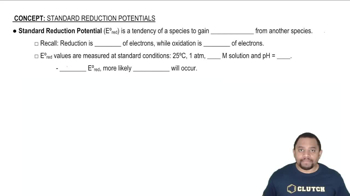
Standard reduction potentials (E°) indicate the tendency of a species to gain electrons and be reduced. Each half-reaction has a specific E° value, which is measured under standard conditions. A higher E° value means a greater likelihood of reduction. When combining half-reactions, the overall cell potential is determined by the difference between the reduction potential of the cathode and the anode.
추천 영상:
가이드 코스
01:10
Standard Reduction Potentials

Cell Potential Calculation

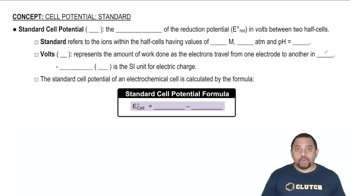
The cell potential (E_cell) for an electrochemical cell is calculated using the formula E_cell = E_cathode - E_anode. This equation helps determine the driving force of the electrochemical reaction. A positive E_cell indicates a spontaneous reaction, while a negative value suggests non-spontaneity. To find the smallest positive cell potential, one must evaluate various combinations of half-reactions.
추천 영상:
가이드 코스
01:27
Standard Cell Potential

Half-Cell Reactions

Half-cell reactions represent the reduction or oxidation processes occurring in an electrochemical cell. Each half-cell consists of a metal ion and its corresponding solid metal, along with electrons. Understanding how to combine these half-reactions is crucial for predicting the overall cell reaction and its potential. The choice of half-cells directly influences the cell potential and the feasibility of the reaction.
추천 영상:
가이드 코스
01:49
First-Order Half-Life