Ch.20 - Electrochemistry
Brown - Chemistry: The Central Science 14th Edition
Brown14th EditionChemistry: The Central ScienceISBN: 9780134414232당신이 사용하는 게 아니라요?교과서 변경
20장, 문제 37b

Using standard reduction potentials (Appendix E), calculate the standard emf for each of the following reactions: (b) Ni1s2 + 2 Ce4+1aq2 ¡ Ni2+1aq2 + 2 Ce3+1aq2

검증된 단계별 안내
1
Identify the half-reactions involved in the overall redox reaction. For the given reaction, the half-reactions are: \( \text{Ni} \rightarrow \text{Ni}^{2+} + 2e^- \) and \( \text{Ce}^{4+} + e^- \rightarrow \text{Ce}^{3+} \).
Look up the standard reduction potentials for each half-reaction in Appendix E. The standard reduction potential for \( \text{Ni}^{2+} + 2e^- \rightarrow \text{Ni} \) is \( E^\circ = -0.25 \text{ V} \), and for \( \text{Ce}^{4+} + e^- \rightarrow \text{Ce}^{3+} \) is \( E^\circ = +1.61 \text{ V} \).
Reverse the reduction potential for the oxidation half-reaction. Since \( \text{Ni} \rightarrow \text{Ni}^{2+} + 2e^- \) is the oxidation half-reaction, its potential becomes \( E^\circ = +0.25 \text{ V} \).
Calculate the standard emf (electromotive force) of the cell by adding the standard potentials of the oxidation and reduction half-reactions: \( E^\circ_{\text{cell}} = E^\circ_{\text{reduction}} + E^\circ_{\text{oxidation}} \).
Substitute the values into the equation: \( E^\circ_{\text{cell}} = 1.61 \text{ V} + 0.25 \text{ V} \).

비슷한 문제에 대한 검증된 영상 답변:

이 영상 해법은 위 문제에 도움이 된다고 튜터들이 추천한 것입니다.
영상 길이:
4m
도움이 되었나요?

주요 개념

질문에 올바르게 답하기 위해 반드시 이해해야 하는 핵심 개념들은 다음과 같습니다.

Standard Reduction Potentials

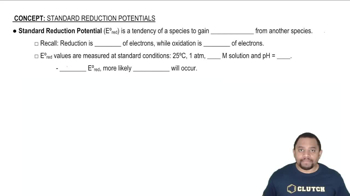
Standard reduction potentials are measured voltages that indicate the tendency of a chemical species to gain electrons and be reduced. Each half-reaction has a specific potential, typically measured under standard conditions (1 M concentration, 1 atm pressure, and 25°C). These values are crucial for predicting the direction of redox reactions and calculating the overall cell potential.
추천 영상:
가이드 코스
01:10
Standard Reduction Potentials

Electrochemical Cell and EMF

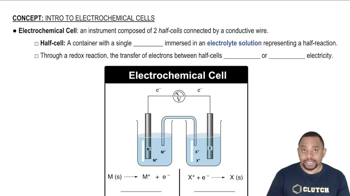
An electrochemical cell consists of two half-cells where oxidation and reduction reactions occur. The electromotive force (EMF) of the cell is the voltage generated by the spontaneous redox reaction, calculated as the difference between the reduction potentials of the cathode and anode. A positive EMF indicates a spontaneous reaction, while a negative EMF suggests non-spontaneity.
추천 영상:
가이드 코스
02:46
Electrochemical Cells

Balancing Redox Reactions

Balancing redox reactions involves ensuring that both mass and charge are conserved in the reaction. This is done by identifying oxidation and reduction half-reactions, balancing the number of electrons transferred, and adjusting coefficients accordingly. Properly balanced reactions are essential for accurate calculations of standard EMF and understanding the stoichiometry of the reaction.
추천 영상:
가이드 코스
01:04
Balancing Basic Redox Reactions