
Ch.21 - Nuclear Chemistry
Brown - Chemistry: The Central Science 14th Edition
Brown14th EditionChemistry: The Central ScienceISBN: 9780134414232당신이 사용하는 게 아니라요?교과서 변경
21장, 문제 92a

A 25.0-mL sample of 0.050 M barium nitrate solution was mixed with 25.0 mL of 0.050 M sodium sulfate solution labeled with radioactive sulfur-35. The activity of the initial sodium sulfate solution was 1.22⨉106 Bq/mL. After the resultant precipitate was removed by filtration, the remaining filtrate was found to have an activity of 250 Bq/mL. (a) Write a balanced chemical equation for the reaction that occurred.

검증된 단계별 안내
1
Step 1: Identify the reactants and products. The reactants are barium nitrate (Ba(NO3)2) and sodium sulfate (Na2SO4). The product is barium sulfate (BaSO4), which is a precipitate, and sodium nitrate (NaNO3).
Step 2: Write the unbalanced chemical equation. Ba(NO3)2 + Na2SO4 → BaSO4 + NaNO3.
Step 3: Balance the chemical equation. The balanced chemical equation is: Ba(NO3)2 + Na2SO4 → BaSO4 + 2NaNO3. This is because there are 2 nitrate ions on the left side and only 1 on the right side in the unbalanced equation. To balance it, we need to have 2 nitrate ions on both sides, which is achieved by adding a coefficient of 2 in front of NaNO3.
Step 4: Check the balanced equation. There should be the same number of each type of atom on the left side of the equation as on the right side. In this case, there are 1 Ba, 2 N, 6 O, 2 Na, and 4 O on both sides, so the equation is balanced.
Step 5: Understand the context of the problem. The radioactive sulfur-35 is used to track the sulfate ions. The decrease in activity from the initial sodium sulfate solution to the filtrate indicates that some of the sulfate ions have been removed from the solution, presumably by forming the barium sulfate precipitate.

비슷한 문제에 대한 검증된 영상 답변:

이 영상 해법은 위 문제에 도움이 된다고 튜터들이 추천한 것입니다.
영상 길이:
6m

주요 개념

질문에 올바르게 답하기 위해 반드시 이해해야 하는 핵심 개념들은 다음과 같습니다.

Precipitation Reactions

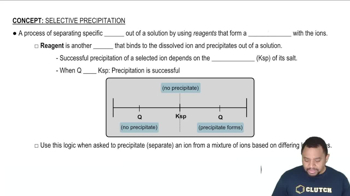
Precipitation reactions occur when two soluble salts react in solution to form an insoluble compound, known as a precipitate. In this case, barium nitrate and sodium sulfate react to form barium sulfate, which is insoluble in water. Understanding the solubility rules helps predict which compounds will precipitate during a reaction.
추천 영상:
가이드 코스
01:53
Selective Precipitation

Balancing Chemical Equations

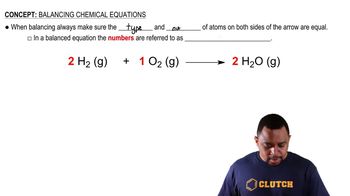
Balancing chemical equations is essential to ensure that the number of atoms of each element is conserved in a reaction. This involves adjusting the coefficients of the reactants and products so that they match. For the reaction between barium nitrate and sodium sulfate, the balanced equation reflects the stoichiometry of the reactants and products involved.
추천 영상:
가이드 코스
01:32
Balancing Chemical Equations

Radioactive Decay and Activity

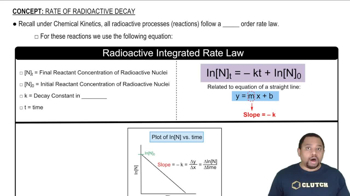
Radioactive decay refers to the process by which unstable atomic nuclei lose energy by emitting radiation. The activity of a radioactive sample, measured in becquerels (Bq), indicates the number of decay events per second. In this scenario, the initial and final activities of the sodium sulfate solution provide insight into the distribution of the radioactive sulfur after the precipitation reaction.
추천 영상:
가이드 코스
03:00
Rate of Radioactive Decay