Ch.21 - Nuclear Chemistry

Brown14th EditionChemistry: The Central ScienceISBN: 9780134414232
당신이 사용하는 게 아니라요?교과서 변경다른 교과서를 선택하세요
TOC.tableOfContents
- Ch.1 - Introduction: Matter, Energy, and Measurement177
- Ch.2 - Atoms, Molecules, and Ions231
- Ch.3 - Chemical Reactions and Reaction Stoichiometry216
- Ch.4 - Reactions in Aqueous Solution189
- Ch.5 - Thermochemistry175
- Ch.6 - Electronic Structure of Atoms168
- Ch.7 - Periodic Properties of the Elements150
- Ch.8 - Basic Concepts of Chemical Bonding177
- Ch.9 - Molecular Geometry and Bonding Theories200
- Ch.10 - Gases179
- Ch.11 - Liquids and Intermolecular Forces113
- Ch.12 - Solids and Modern Materials154
- Ch.13 - Properties of Solutions157
- Ch.14 - Chemical Kinetics199
- Ch.15 - Chemical Equilibrium128
- Ch.16 - Acid-Base Equilibria164
- Ch.17 - Additional Aspects of Aqueous Equilibria163
- Ch.18 - Chemistry of the Environment105
- Ch.19 - Chemical Thermodynamics164
- Ch.20 - Electrochemistry171
- Ch.21 - Nuclear Chemistry122
- Ch.22 - Chemistry of the Nonmetals82
- Ch.23 - Transition Metals and Coordination Chemistry79
- Ch.24 - The Chemistry of Life: Organic and Biological Chemistry16

21장, 문제 87
A 53.8-mg sample of sodium perchlorate contains radioactive chlorine-36 (whose atomic mass is 36.0 amu). If 29.6% of the chlorine atoms in the sample are chlorine-36 and the remainder are naturally occurring nonradioactive chlorine atoms, how many disintegrations per second are produced by this sample? The half-life of chlorine-36 is 3.0 * 105 yr.
 검증된 단계별 안내
1
Convert the mass of the sodium perchlorate sample from milligrams to grams by dividing by 1000.
Calculate the molar mass of sodium perchlorate (NaClO₄) using the atomic masses of sodium (Na), chlorine (Cl), and oxygen (O).
Determine the number of moles of sodium perchlorate in the sample by dividing the mass of the sample in grams by the molar mass of sodium perchlorate.
Calculate the total number of chlorine atoms in the sample by multiplying the number of moles of sodium perchlorate by Avogadro's number (6.022 x 10²³ atoms/mol).
Find the number of chlorine-36 atoms by multiplying the total number of chlorine atoms by the percentage of chlorine-36 (29.6%).
주요 개념
질문에 올바르게 답하기 위해 반드시 이해해야 하는 핵심 개념들은 다음과 같습니다.
Radioactive Decay
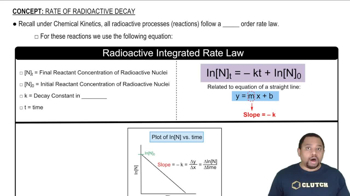
Radioactive decay is the process by which unstable atomic nuclei lose energy by emitting radiation. This decay occurs at a predictable rate characterized by the half-life, which is the time required for half of the radioactive atoms in a sample to decay. Understanding this concept is crucial for calculating the activity of a radioactive sample, as it directly relates to the number of disintegrations per second.
추천 영상:
가이드 코스
 03:00
03:00
Rate of Radioactive Decay
Half-Life
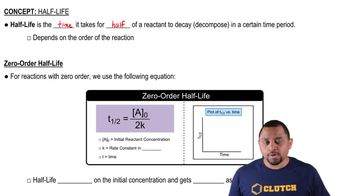
The half-life of a radioactive isotope is the time it takes for half of the radioactive atoms in a sample to decay. For chlorine-36, the half-life is 3.0 × 10^5 years, meaning that after this period, only half of the original amount of chlorine-36 will remain. This concept is essential for determining the remaining quantity of a radioactive substance over time and calculating its activity.
추천 영상:
가이드 코스
 02:17
02:17Zero-Order Half-life
Activity of a Radioactive Sample
The activity of a radioactive sample, measured in disintegrations per second (Becquerels), indicates the rate at which decay events occur. It can be calculated using the formula A = λN, where A is the activity, λ is the decay constant, and N is the number of radioactive atoms present. Understanding how to calculate activity is vital for determining the safety and implications of handling radioactive materials.
추천 영상:
가이드 코스
 02:02
02:02Activity Series Chart
관련 실천