Ch.21 - Nuclear Chemistry
Brown - Chemistry: The Central Science 14th Edition
Brown14th EditionChemistry: The Central ScienceISBN: 9780134414232당신이 사용하는 게 아니라요?교과서 변경
21장, 문제 33

Each statement that follows refers to a comparison between two radioisotopes, A and X. Indicate whether each of the following statements is true or false. (a) If the half-life for A is shorter than the half-life for X, A has a larger decay rate constant.

검증된 단계별 안내
1
Understand the relationship between half-life and decay rate constant. The half-life \( t_{1/2} \) of a radioactive isotope is related to its decay rate constant \( k \) by the equation: \( t_{1/2} = \frac{0.693}{k} \).
Recognize that a shorter half-life means the isotope decays more quickly.
From the equation \( t_{1/2} = \frac{0.693}{k} \), observe that if the half-life \( t_{1/2} \) is shorter, the decay rate constant \( k \) must be larger to maintain the equality.
Apply this understanding to the problem: If isotope A has a shorter half-life than isotope X, then isotope A must have a larger decay rate constant than isotope X.
Conclude that the statement is true based on the mathematical relationship between half-life and decay rate constant.

비슷한 문제에 대한 검증된 영상 답변:

이 영상 해법은 위 문제에 도움이 된다고 튜터들이 추천한 것입니다.
영상 길이:
2m
도움이 되었나요?

주요 개념

질문에 올바르게 답하기 위해 반드시 이해해야 하는 핵심 개념들은 다음과 같습니다.

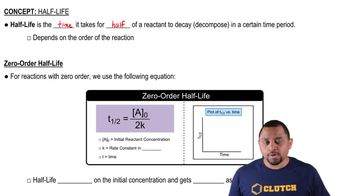
Half-Life

Half-life is the time required for half of the radioactive nuclei in a sample to decay. It is a crucial concept in nuclear chemistry, as it helps determine the stability and longevity of a radioisotope. A shorter half-life indicates that a substance decays more quickly, which is essential for understanding the behavior of radioactive materials.
추천 영상:
가이드 코스
02:17
Zero-Order Half-life

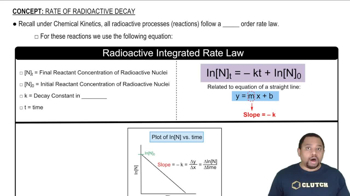
Decay Rate Constant

The decay rate constant (λ) is a proportionality constant that quantifies the rate at which a radioactive substance decays. It is related to the half-life by the equation λ = ln(2) / t½. A larger decay rate constant signifies a faster decay process, which is directly linked to the half-life of the isotope.
추천 영상:
가이드 코스
03:00
Rate of Radioactive Decay

Radioactive Decay

Radioactive decay is the process by which an unstable atomic nucleus loses energy by emitting radiation. This process can occur in various forms, including alpha, beta, and gamma decay. Understanding radioactive decay is essential for comparing isotopes, as it influences their half-lives and decay rate constants, thereby affecting their stability and applications in fields like medicine and energy.
추천 영상:
가이드 코스
03:00
Rate of Radioactive Decay