Ch.21 - Nuclear Chemistry
Brown - Chemistry: The Central Science 14th Edition
Brown14th EditionChemistry: The Central ScienceISBN: 9780134414232당신이 사용하는 게 아니라요?교과서 변경
21장, 문제 9b

Indicate the number of protons and neutrons in the following nuclei: (b) 193Tl.

검증된 단계별 안내
1
Identify the element from the given symbol: Tl is the symbol for thallium.
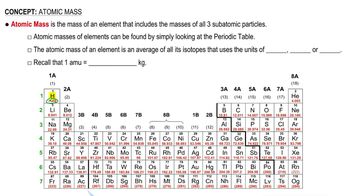
Determine the atomic number of thallium from the periodic table, which is 81. This number represents the number of protons in the nucleus.
The given isotope is 193Tl, where 193 is the mass number (A).
Calculate the number of neutrons using the formula: Neutrons = Mass number (A) - Atomic number (Z).
Substitute the known values into the formula: Neutrons = 193 - 81.

비슷한 문제에 대한 검증된 영상 답변:

이 영상 해법은 위 문제에 도움이 된다고 튜터들이 추천한 것입니다.
영상 길이:
2m

주요 개념

질문에 올바르게 답하기 위해 반드시 이해해야 하는 핵심 개념들은 다음과 같습니다.

Atomic Number

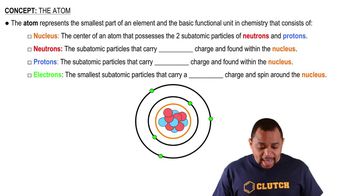
The atomic number of an element is the number of protons found in the nucleus of an atom. It uniquely identifies an element and determines its position on the periodic table. For example, thallium (Tl) has an atomic number of 81, meaning it has 81 protons.
추천 영상:

Mass Number

The mass number of an atom is the total number of protons and neutrons in its nucleus. It is represented as a whole number and is crucial for identifying isotopes of an element. In the case of 193Tl, the mass number is 193, indicating the combined total of protons and neutrons.
추천 영상:

Neutrons

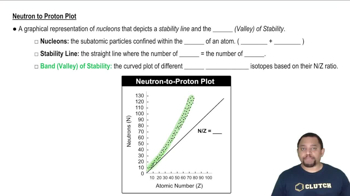
Neutrons are neutral subatomic particles found in the nucleus of an atom, alongside protons. The number of neutrons can be calculated by subtracting the atomic number from the mass number. For 193Tl, with 81 protons, the number of neutrons is 193 - 81 = 112.
추천 영상:
가이드 코스
01:38
Neutron-to-Proton Plot