Ch.21 - Nuclear Chemistry
Brown - Chemistry: The Central Science 14th Edition
Brown14th EditionChemistry: The Central ScienceISBN: 9780134414232당신이 사용하는 게 아니라요?교과서 변경
21장, 문제 41

The cloth shroud from around a mummy is found to have a 14C activity of 9.7 disintegrations per minute per gram of carbon as compared with living organisms that undergo 16.3 disintegrations per minute per gram of carbon. From the half-life for 14C decay, 5715 yr, calculate the age of the shroud.

검증된 단계별 안내
1
Identify the initial and final activities of the carbon-14. The initial activity (A_0) is 16.3 disintegrations per minute per gram, and the final activity (A) is 9.7 disintegrations per minute per gram.
Use the formula for radioactive decay: \( A = A_0 \times e^{-\lambda t} \), where \( \lambda \) is the decay constant and \( t \) is the time elapsed.
Calculate the decay constant \( \lambda \) using the half-life formula: \( \lambda = \frac{\ln(2)}{\text{half-life}} \). Substitute the given half-life of 5715 years into the formula.
Rearrange the decay formula to solve for \( t \): \( t = \frac{\ln(A_0/A)}{\lambda} \).
Substitute the known values of \( A_0 \), \( A \), and \( \lambda \) into the equation to calculate the age \( t \) of the shroud.

비슷한 문제에 대한 검증된 영상 답변:

이 영상 해법은 위 문제에 도움이 된다고 튜터들이 추천한 것입니다.
영상 길이:
5m

주요 개념

질문에 올바르게 답하기 위해 반드시 이해해야 하는 핵심 개념들은 다음과 같습니다.

Radiocarbon Dating

Radiocarbon dating is a method used to determine the age of organic materials by measuring the amount of carbon-14 (14C) remaining in a sample. Living organisms continuously exchange carbon with their environment, maintaining a constant ratio of 14C to 12C. Upon death, this exchange stops, and the 14C begins to decay at a known rate, characterized by its half-life of 5715 years.

Half-Life

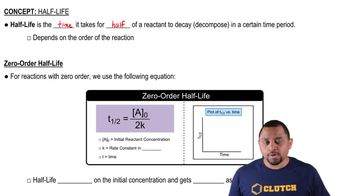
The half-life of a radioactive isotope is the time required for half of the isotope in a sample to decay. For carbon-14, this period is approximately 5715 years. Understanding half-life is crucial for calculating the age of ancient organic materials, as it allows scientists to determine how many half-lives have passed since the organism's death based on the remaining 14C activity.
추천 영상:
가이드 코스
02:17
Zero-Order Half-life

Disintegration Rate

The disintegration rate refers to the number of radioactive decays occurring in a sample per unit time, typically measured in disintegrations per minute (dpm). In the context of radiocarbon dating, comparing the disintegration rates of a sample to that of a living organism helps estimate the time elapsed since the organism's death, providing a basis for age calculation.
추천 영상:
가이드 코스
01:30
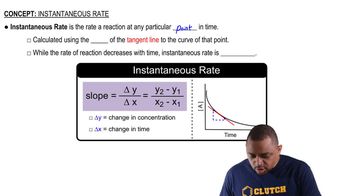
Instantaneous Rate