Ch.21 - Nuclear Chemistry
Brown - Chemistry: The Central Science 14th Edition
Brown14th EditionChemistry: The Central ScienceISBN: 9780134414232당신이 사용하는 게 아니라요?교과서 변경
21장, 문제 64b

The spent fuel elements from a fission reactor are much more intensely radioactive than the original fuel elements. (b) Given that only two or three neutrons are released per fission event and knowing that the nucleus undergoing fission has a neutron-to-proton ratio characteristic of a heavy nucleus, what sorts of decay would you expect to be dominant among the fission products?
Graph showing mass number vs atomic number for fission products in nuclear decay.

검증된 단계별 안내
1
Identify the neutron-to-proton ratio in the fission products, which is higher than in stable nuclei.
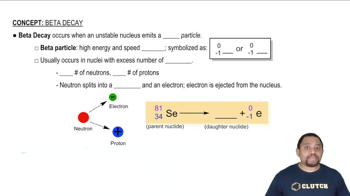
Recognize that fission products are neutron-rich and will likely undergo beta decay to convert neutrons into protons.
Observe the graph showing the decay series, noting the transitions between elements.
Notice the presence of alpha decay in the series, where heavy nuclei emit alpha particles (helium nuclei) to become more stable.
Conclude that the dominant decay modes among fission products are beta decay and alpha decay, as indicated by the transitions in the graph.

비슷한 문제에 대한 검증된 영상 답변:

이 영상 해법은 위 문제에 도움이 된다고 튜터들이 추천한 것입니다.
영상 길이:
10m

주요 개념

질문에 올바르게 답하기 위해 반드시 이해해야 하는 핵심 개념들은 다음과 같습니다.

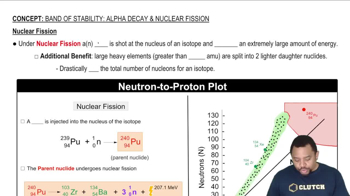
Nuclear Fission

Nuclear fission is the process by which a heavy nucleus splits into two or more smaller nuclei, along with the release of energy and neutrons. This reaction is typically initiated by the absorption of a neutron by the nucleus. The released neutrons can then induce further fission events, leading to a chain reaction, which is the principle behind nuclear reactors.
추천 영상:
가이드 코스
03:29
Band of Stability: Nuclear Fission

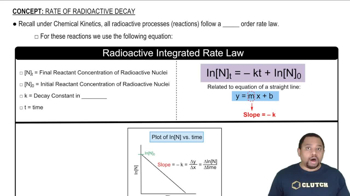
Radioactive Decay

Radioactive decay is the process by which an unstable atomic nucleus loses energy by emitting radiation. This can occur through various modes, including alpha decay, beta decay, and gamma decay. The type of decay that predominates depends on the neutron-to-proton ratio of the nucleus, with heavy nuclei often undergoing alpha decay to achieve stability.
추천 영상:
가이드 코스
03:00
Rate of Radioactive Decay

Decay Chains

Decay chains refer to a series of radioactive decays that occur as unstable isotopes transform into more stable forms. Each step in the chain involves the emission of particles or radiation, leading to different isotopes until a stable isotope is reached. In the context of fission products, these chains can result in a variety of decay products, often including isotopes of lead, bismuth, and polonium.
추천 영상: