
Ch.21 - Nuclear Chemistry
Brown - Chemistry: The Central Science 14th Edition
Brown14th EditionChemistry: The Central ScienceISBN: 9780134414232당신이 사용하는 게 아니라요?교과서 변경
21장, 문제 26

Which of the following nuclides would you expect to be radioactive: 5826Fe, 6027Co, 9241Nb, mercury-202, radium-226? Justify your choices.

검증된 단계별 안내
1
Step 1: Understand that the stability of a nuclide is determined by the ratio of neutrons to protons. For lighter elements (atomic number less than 20), the ratio is approximately 1:1. For heavier elements, the ratio is closer to 1.5:1. Nuclides that fall outside these ratios are likely to be radioactive.
Step 2: Calculate the neutron to proton ratio for each nuclide. For example, for 5826Fe, the number of neutrons is 58 - 26 = 32 and the number of protons is 26. So, the ratio is 32/26.
Step 3: Compare the calculated ratios with the expected ratios. If the calculated ratio is significantly different from the expected ratio, the nuclide is likely to be radioactive.
Step 4: Remember that all isotopes of elements with atomic numbers greater than 83 (bismuth) are radioactive. So, without doing any calculations, you can conclude that radium-226 is radioactive because radium has an atomic number of 88.
Step 5: For mercury-202, you would need to calculate the neutron to proton ratio and compare it to the expected ratio. However, it's worth noting that mercury-202 is a well-known stable isotope of mercury.

비슷한 문제에 대한 검증된 영상 답변:

이 영상 해법은 위 문제에 도움이 된다고 튜터들이 추천한 것입니다.
영상 길이:
3m

주요 개념

질문에 올바르게 답하기 위해 반드시 이해해야 하는 핵심 개념들은 다음과 같습니다.

Nuclear Stability

Nuclear stability refers to the balance between protons and neutrons in an atomic nucleus. Stable nuclides have a specific ratio of these particles, while unstable nuclides tend to have too many or too few neutrons, leading to radioactivity. Understanding this concept helps predict which isotopes are likely to undergo radioactive decay.
추천 영상:
가이드 코스
03:29
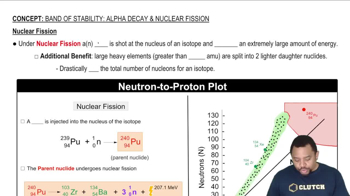
Band of Stability: Nuclear Fission

Types of Radioactive Decay

Radioactive decay is the process by which an unstable atomic nucleus loses energy by emitting radiation. There are several types of decay, including alpha, beta, and gamma decay, each characterized by the particles emitted. Recognizing the type of decay can help in understanding the behavior of specific nuclides and their potential radioactivity.
추천 영상:
가이드 코스
03:00
Rate of Radioactive Decay

Isotopes and Their Stability

Isotopes are variants of a chemical element that have the same number of protons but different numbers of neutrons. Some isotopes are stable, while others are radioactive. Identifying the isotopes of elements in the question allows for an assessment of their stability and likelihood of being radioactive, which is crucial for answering the question.
추천 영상: