
Ch.21 - Nuclear Chemistry
Brown - Chemistry: The Central Science 14th Edition
Brown14th EditionChemistry: The Central ScienceISBN: 9780134414232당신이 사용하는 게 아니라요?교과서 변경
21장, 문제 2

Write the balanced nuclear equation for the reaction represented by the diagram shown here. [Section 21.2]
Diagram illustrating beta decay with two points connected by a red arrow.

검증된 단계별 안내
1
Identify the initial and final nuclei in the diagram. The initial nucleus is at (Z, N) = (6, 8), which corresponds to Carbon-14 (14^C). The final nucleus is at (Z, N) = (7, 7), which corresponds to Nitrogen-14 (14^N).
Recognize that the red arrow indicates a beta decay process, where a neutron is converted into a proton, emitting a beta particle (electron) and an antineutrino.
Write the general form of the beta decay equation: ^A_ZX -> ^A_{Z+1}Y + ^0_{-1}e + antineutrino.
Substitute the identified nuclei into the equation: ^14_6C -> ^14_7N + ^0_{-1}e + antineutrino.
Ensure the equation is balanced in terms of both mass number (A) and atomic number (Z). The mass number remains 14 on both sides, and the atomic number increases from 6 to 7, with the emission of a beta particle (electron) balancing the charge.

비슷한 문제에 대한 검증된 영상 답변:

이 영상 해법은 위 문제에 도움이 된다고 튜터들이 추천한 것입니다.
영상 길이:
5m
도움이 되었나요?

주요 개념

질문에 올바르게 답하기 위해 반드시 이해해야 하는 핵심 개념들은 다음과 같습니다.

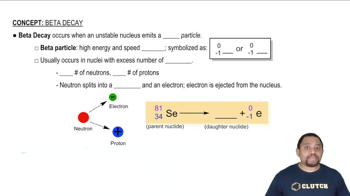
Beta Decay

Beta decay is a type of radioactive decay in which a beta particle (an electron or a positron) is emitted from an atomic nucleus. This process occurs when a neutron in the nucleus transforms into a proton, emitting an electron (beta-minus decay) or when a proton transforms into a neutron, emitting a positron (beta-plus decay). Understanding beta decay is crucial for writing balanced nuclear equations.
추천 영상:

Nuclear Equation

A nuclear equation represents the transformation of atomic nuclei during radioactive decay or nuclear reactions. It includes the symbols for the reactants and products, along with their atomic numbers and mass numbers. Balancing nuclear equations is essential to ensure that the number of nucleons (protons and neutrons) and charge are conserved during the reaction.
추천 영상:
가이드 코스
02:06
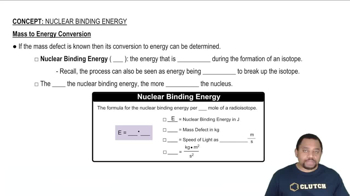
Nuclear Binding Energy

Conservation of Mass and Charge

In nuclear reactions, the conservation of mass and charge states that the total mass number and total charge must remain constant before and after the reaction. This principle is fundamental when balancing nuclear equations, as it ensures that the number of protons and neutrons, as well as the overall charge, are equal on both sides of the equation.
추천 영상:
가이드 코스
01:48
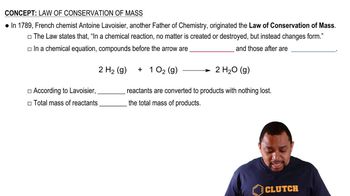
Law of Conservation of Mass