Ch.22 - Chemistry of the Nonmetals

Brown14th EditionChemistry: The Central ScienceISBN: 9780134414232
당신이 사용하는 게 아니라요?교과서 변경다른 교과서를 선택하세요
TOC.tableOfContents
- Ch.1 - Introduction: Matter, Energy, and Measurement177
- Ch.2 - Atoms, Molecules, and Ions231
- Ch.3 - Chemical Reactions and Reaction Stoichiometry216
- Ch.4 - Reactions in Aqueous Solution189
- Ch.5 - Thermochemistry175
- Ch.6 - Electronic Structure of Atoms168
- Ch.7 - Periodic Properties of the Elements150
- Ch.8 - Basic Concepts of Chemical Bonding177
- Ch.9 - Molecular Geometry and Bonding Theories200
- Ch.10 - Gases179
- Ch.11 - Liquids and Intermolecular Forces113
- Ch.12 - Solids and Modern Materials154
- Ch.13 - Properties of Solutions157
- Ch.14 - Chemical Kinetics199
- Ch.15 - Chemical Equilibrium128
- Ch.16 - Acid-Base Equilibria164
- Ch.17 - Additional Aspects of Aqueous Equilibria163
- Ch.18 - Chemistry of the Environment105
- Ch.19 - Chemical Thermodynamics164
- Ch.20 - Electrochemistry171
- Ch.21 - Nuclear Chemistry122
- Ch.22 - Chemistry of the Nonmetals82
- Ch.23 - Transition Metals and Coordination Chemistry79
- Ch.24 - The Chemistry of Life: Organic and Biological Chemistry16

22장, 문제 25
Complete the exercises below. Identify the following hydrides as ionic, metallic, or molecular: a. BaH₂, b. H₂Te, c. TiH₁.₇.
 검증된 단계별 안내
1
Step 1: Understand the types of hydrides. Hydrides can be classified into three main types: ionic hydrides, metallic hydrides, and molecular hydrides. Ionic hydrides typically form between hydrogen and alkali or alkaline earth metals. Metallic hydrides involve transition metals, and molecular hydrides are usually formed with nonmetals.
Step 2: Analyze BaH₂. Barium (Ba) is an alkaline earth metal. Hydrides formed with alkaline earth metals are typically ionic. Therefore, BaH₂ is likely an ionic hydride.
Step 3: Analyze H₂Te. Tellurium (Te) is a nonmetal. Hydrides formed with nonmetals are usually molecular. Therefore, H₂Te is likely a molecular hydride.
Step 4: Analyze TiH₁.₇. Titanium (Ti) is a transition metal. Hydrides formed with transition metals are typically metallic. Therefore, TiH₁.₇ is likely a metallic hydride.
Step 5: Summarize the classifications. Based on the analysis, BaH₂ is an ionic hydride, H₂Te is a molecular hydride, and TiH₁.₇ is a metallic hydride.
주요 개념
질문에 올바르게 답하기 위해 반드시 이해해야 하는 핵심 개념들은 다음과 같습니다.
Ionic Compounds
Ionic compounds are formed when atoms transfer electrons, resulting in the formation of charged ions. These compounds typically consist of a metal and a non-metal, where the metal donates electrons and the non-metal accepts them. Ionic bonds are characterized by strong electrostatic forces between the oppositely charged ions, leading to high melting and boiling points.
추천 영상:
가이드 코스
 02:11
02:11
Ionic Compounds Naming
Molecular Compounds
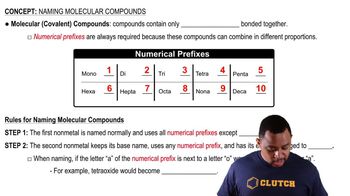
Molecular compounds are formed when two or more non-metals share electrons through covalent bonds. These compounds consist of discrete molecules, and their properties differ significantly from ionic compounds. Molecular compounds generally have lower melting and boiling points and can exist in various states (solid, liquid, gas) at room temperature, depending on the strength of intermolecular forces.
추천 영상:
가이드 코스
 02:06
02:06Naming Molecular Compounds
Metallic Compounds
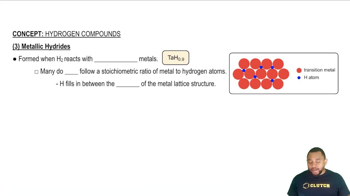
Metallic compounds consist of metal atoms that share a 'sea of electrons' allowing for conductivity and malleability. In metallic bonding, electrons are not bound to any specific atom, which enables the metal atoms to slide past each other without breaking the bond. This unique structure gives metals their characteristic properties, such as luster and the ability to conduct electricity and heat.
추천 영상:
가이드 코스
 01:00
01:00Metallic Hydrides
관련 실천