Ch.22 - Chemistry of the Nonmetals

Brown14th EditionChemistry: The Central ScienceISBN: 9780134414232
당신이 사용하는 게 아니라요?교과서 변경다른 교과서를 선택하세요
TOC.tableOfContents
- Ch.1 - Introduction: Matter, Energy, and Measurement177
- Ch.2 - Atoms, Molecules, and Ions231
- Ch.3 - Chemical Reactions and Reaction Stoichiometry216
- Ch.4 - Reactions in Aqueous Solution189
- Ch.5 - Thermochemistry175
- Ch.6 - Electronic Structure of Atoms168
- Ch.7 - Periodic Properties of the Elements150
- Ch.8 - Basic Concepts of Chemical Bonding177
- Ch.9 - Molecular Geometry and Bonding Theories200
- Ch.10 - Gases179
- Ch.11 - Liquids and Intermolecular Forces113
- Ch.12 - Solids and Modern Materials154
- Ch.13 - Properties of Solutions157
- Ch.14 - Chemical Kinetics199
- Ch.15 - Chemical Equilibrium128
- Ch.16 - Acid-Base Equilibria164
- Ch.17 - Additional Aspects of Aqueous Equilibria163
- Ch.18 - Chemistry of the Environment105
- Ch.19 - Chemical Thermodynamics164
- Ch.20 - Electrochemistry171
- Ch.21 - Nuclear Chemistry122
- Ch.22 - Chemistry of the Nonmetals82
- Ch.23 - Transition Metals and Coordination Chemistry79
- Ch.24 - The Chemistry of Life: Organic and Biological Chemistry16

22장, 문제 29
Complete the exercises below: Why does xenon form stable compounds with fluorine, whereas argon does not?
 검증된 단계별 안내
1
Step 1: Understand the electronic configuration of xenon and argon. Xenon has the electronic configuration [Kr] 4d^{10} 5s^{2} 5p^{6}, while argon has [Ne] 3s^{2} 3p^{6}.
Step 2: Recognize that xenon is a noble gas with a complete outer shell, but it has empty d orbitals in its valence shell that can be used for bonding.
Step 3: Note that argon, being a smaller noble gas, does not have available d orbitals in its valence shell, limiting its ability to expand its octet and form compounds.
Step 4: Consider the electronegativity and reactivity of fluorine, which is highly electronegative and can attract electrons from xenon, allowing xenon to form stable compounds like XeF_2, XeF_4, and XeF_6.
Step 5: Conclude that the ability of xenon to form stable compounds with fluorine is due to its larger atomic size and the availability of d orbitals, which argon lacks, preventing it from forming similar compounds.
주요 개념
질문에 올바르게 답하기 위해 반드시 이해해야 하는 핵심 개념들은 다음과 같습니다.
Noble Gas Stability
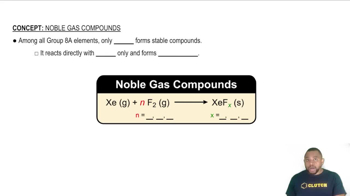
Noble gases, such as argon and xenon, have a full valence shell, making them generally unreactive. However, xenon can form stable compounds due to its larger atomic size and the ability to expand its octet, allowing it to accommodate more than eight electrons. In contrast, argon, being smaller, does not have the same capacity to form stable compounds with highly electronegative elements like fluorine.
추천 영상:
가이드 코스
 00:59
00:59
Noble Gas Compounds
Chemical Reactivity of Halogens
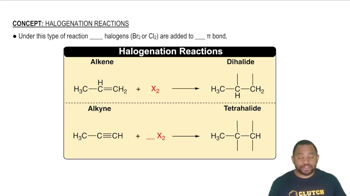
Halogens, such as fluorine, are highly reactive due to their strong tendency to gain an electron and achieve a stable octet configuration. When reacting with xenon, fluorine can form stable compounds like xenon difluoride (XeF2) because xenon can accommodate additional electrons. Argon, however, does not readily react with halogens, as it lacks the ability to form stable bonds with them.
추천 영상:
가이드 코스
 01:11
01:11Halogenation Reactions
Bonding and Molecular Orbital Theory
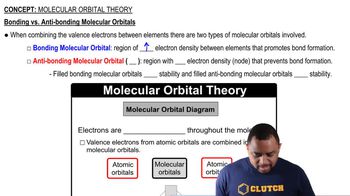
Molecular orbital theory explains how atomic orbitals combine to form molecular orbitals, which can be occupied by electrons. In xenon-fluorine compounds, the overlap of orbitals allows for the formation of stable bonds. Argon, lacking the ability to form such molecular orbitals with fluorine, does not participate in bonding, resulting in its inability to form stable compounds.
추천 영상:
가이드 코스
 03:06
03:06Molecular Orbital Theory
관련 실천