Ch.22 - Chemistry of the Nonmetals

Brown14th EditionChemistry: The Central ScienceISBN: 9780134414232
당신이 사용하는 게 아니라요?교과서 변경다른 교과서를 선택하세요
TOC.tableOfContents
- Ch.1 - Introduction: Matter, Energy, and Measurement177
- Ch.2 - Atoms, Molecules, and Ions231
- Ch.3 - Chemical Reactions and Reaction Stoichiometry216
- Ch.4 - Reactions in Aqueous Solution189
- Ch.5 - Thermochemistry175
- Ch.6 - Electronic Structure of Atoms168
- Ch.7 - Periodic Properties of the Elements150
- Ch.8 - Basic Concepts of Chemical Bonding177
- Ch.9 - Molecular Geometry and Bonding Theories200
- Ch.10 - Gases179
- Ch.11 - Liquids and Intermolecular Forces113
- Ch.12 - Solids and Modern Materials154
- Ch.13 - Properties of Solutions157
- Ch.14 - Chemical Kinetics199
- Ch.15 - Chemical Equilibrium128
- Ch.16 - Acid-Base Equilibria164
- Ch.17 - Additional Aspects of Aqueous Equilibria163
- Ch.18 - Chemistry of the Environment105
- Ch.19 - Chemical Thermodynamics164
- Ch.20 - Electrochemistry171
- Ch.21 - Nuclear Chemistry122
- Ch.22 - Chemistry of the Nonmetals82
- Ch.23 - Transition Metals and Coordination Chemistry79
- Ch.24 - The Chemistry of Life: Organic and Biological Chemistry16

22장, 문제 54
Complete the exercises below. Write a balanced net ionic equation for each of the following reactions: a. Dilute nitric acid reacts with zinc metal with formation of nitrous oxide. b. Concentrated nitric acid reacts with sulfur with formation of nitrogen dioxide. c. Concentrated nitric acid oxidizes sulfur dioxide with formation of nitric oxide. d. Hydrazine is burned in excess fluorine gas, forming NF₃. e. Hydrazine reduces CrO₄²⁻ to Cr(OH)₄⁻ in base (hydrazine is oxidized to N₂).
 검증된 단계별 안내
1
Step 1: Identify the reactants and products for each reaction. For example, in reaction (a), the reactants are dilute nitric acid (HNO₃) and zinc metal (Zn), and the products include nitrous oxide (N₂O).
Step 2: Write the balanced molecular equation for each reaction. For reaction (a), this involves balancing the atoms on both sides of the equation, ensuring that the number of each type of atom is the same on both sides.
Step 3: Determine the states of matter for each compound in the reaction (solid, liquid, gas, aqueous) and write the complete ionic equation by separating all aqueous compounds into their respective ions.
Step 4: Identify and cancel out the spectator ions, which are ions that appear on both sides of the complete ionic equation and do not participate in the actual chemical change.
Step 5: Write the net ionic equation by including only the species that undergo a change during the reaction. Ensure that the equation is balanced in terms of both mass and charge.
주요 개념
질문에 올바르게 답하기 위해 반드시 이해해야 하는 핵심 개념들은 다음과 같습니다.
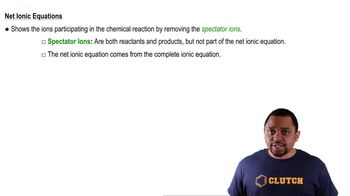
Net Ionic Equations
Net ionic equations represent the actual chemical species that participate in a reaction, excluding spectator ions. They focus on the ions and molecules that undergo a change during the reaction, providing a clearer picture of the chemical processes involved. To write a net ionic equation, one must first write the complete ionic equation and then eliminate the spectator ions.
추천 영상:
가이드 코스
 00:51
00:51
Net Ionic Equations
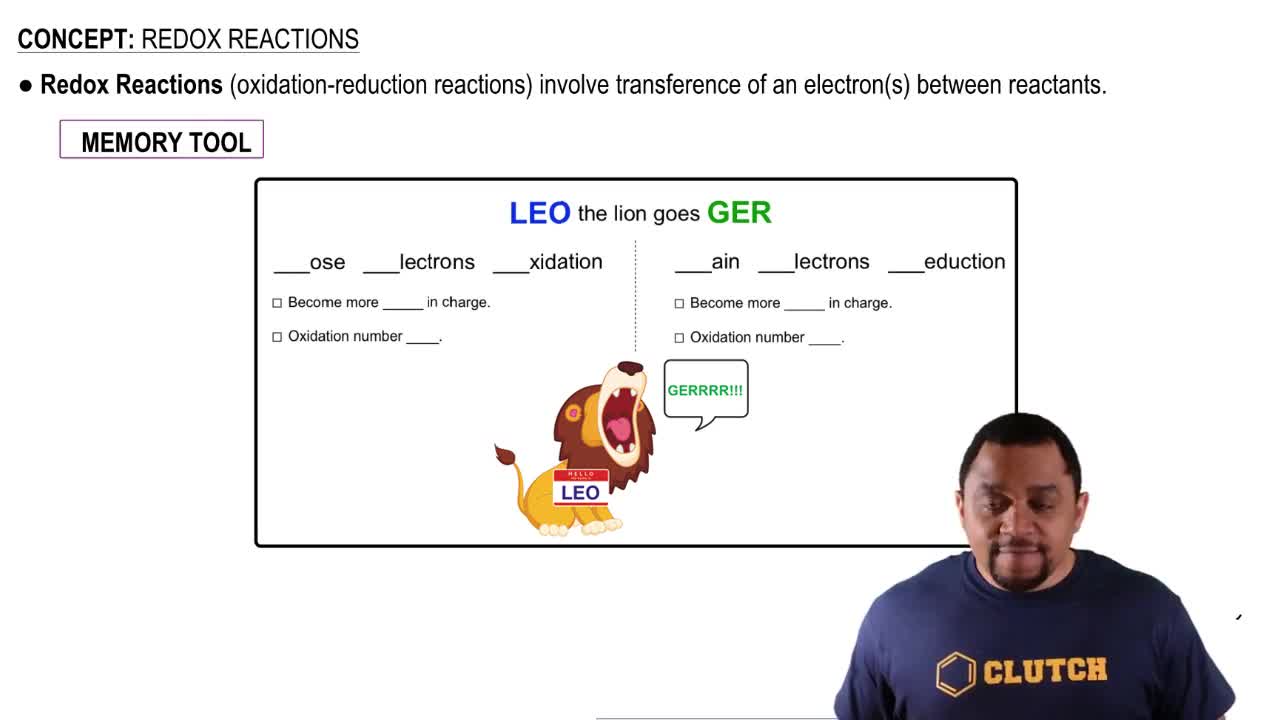
Oxidation-Reduction Reactions
Oxidation-reduction (redox) reactions involve the transfer of electrons between species, resulting in changes in oxidation states. In these reactions, one species is oxidized (loses electrons) while another is reduced (gains electrons). Understanding how to identify oxidizing and reducing agents is crucial for balancing redox reactions and writing accurate net ionic equations.
추천 영상:
가이드 코스
 01:53
01:53Oxidation and Reduction Reactions
Acid-Base Reactions
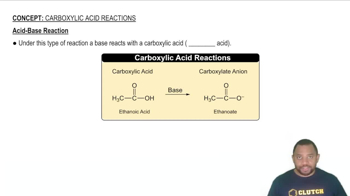
Acid-base reactions involve the transfer of protons (H⁺ ions) between reactants. In the context of the question, nitric acid acts as a strong acid that can donate protons, influencing the behavior of metals and nonmetals in reactions. Recognizing the role of acids and bases is essential for predicting products and writing balanced equations, especially in reactions involving oxidation and reduction.
추천 영상:
가이드 코스
 01:09
01:09Acid-Base Reaction
관련 실천