Ch.22 - Chemistry of the Nonmetals

Brown14th EditionChemistry: The Central ScienceISBN: 9780134414232
당신이 사용하는 게 아니라요?교과서 변경다른 교과서를 선택하세요
TOC.tableOfContents
- Ch.1 - Introduction: Matter, Energy, and Measurement177
- Ch.2 - Atoms, Molecules, and Ions231
- Ch.3 - Chemical Reactions and Reaction Stoichiometry216
- Ch.4 - Reactions in Aqueous Solution189
- Ch.5 - Thermochemistry175
- Ch.6 - Electronic Structure of Atoms168
- Ch.7 - Periodic Properties of the Elements150
- Ch.8 - Basic Concepts of Chemical Bonding177
- Ch.9 - Molecular Geometry and Bonding Theories200
- Ch.10 - Gases179
- Ch.11 - Liquids and Intermolecular Forces113
- Ch.12 - Solids and Modern Materials154
- Ch.13 - Properties of Solutions157
- Ch.14 - Chemical Kinetics199
- Ch.15 - Chemical Equilibrium128
- Ch.16 - Acid-Base Equilibria164
- Ch.17 - Additional Aspects of Aqueous Equilibria163
- Ch.18 - Chemistry of the Environment105
- Ch.19 - Chemical Thermodynamics164
- Ch.20 - Electrochemistry171
- Ch.21 - Nuclear Chemistry122
- Ch.22 - Chemistry of the Nonmetals82
- Ch.23 - Transition Metals and Coordination Chemistry79
- Ch.24 - The Chemistry of Life: Organic and Biological Chemistry16

22장, 문제 67
Complete the exercises below. Write a balanced equation for each of the following reactions: a. Hydrogen cyanide is formed commercially by passing a mixture of methane, ammonia, and air over a catalyst at 800 °C. Water is a by-product of the reaction. b. Baking soda reacts with acids to produce carbon dioxide gas. c. When barium carbonate reacts in air with sulfur dioxide, barium sulfate and carbon dioxide form.
 검증된 단계별 안내
1
Identify the reactants and products for each reaction. For reaction (a), the reactants are methane (CH_4), ammonia (NH_3), and oxygen (O_2) from air, and the products are hydrogen cyanide (HCN) and water (H_2O).
Write the unbalanced chemical equation for reaction (a): CH_4 + NH_3 + O_2 → HCN + H_2O.
Balance the chemical equation for reaction (a) by adjusting the coefficients to ensure the same number of each type of atom on both sides of the equation.
For reaction (b), identify the reactants and products: baking soda (NaHCO_3) reacts with an acid (e.g., HCl) to produce carbon dioxide (CO_2), water (H_2O), and a salt (e.g., NaCl).
Write and balance the chemical equation for reaction (b): NaHCO_3 + HCl → CO_2 + H_2O + NaCl.
주요 개념
질문에 올바르게 답하기 위해 반드시 이해해야 하는 핵심 개념들은 다음과 같습니다.
Balancing Chemical Equations
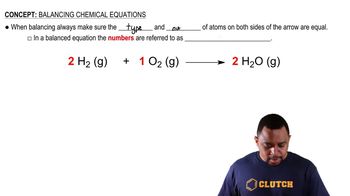
Balancing chemical equations is the process of ensuring that the number of atoms for each element is the same on both the reactant and product sides of the equation. This is based on the law of conservation of mass, which states that matter cannot be created or destroyed in a chemical reaction. A balanced equation provides a clear representation of the reactants and products involved, allowing for accurate stoichiometric calculations.
추천 영상:
가이드 코스
 01:32
01:32
Balancing Chemical Equations
Types of Chemical Reactions
Understanding the types of chemical reactions is essential for predicting the products of a reaction. Common types include synthesis, decomposition, single replacement, and double replacement reactions. For example, the reaction of baking soda with acids is a classic acid-base reaction that produces carbon dioxide gas, while the reaction of barium carbonate with sulfur dioxide involves a combination of a carbonate and a sulfur dioxide, leading to the formation of sulfate and carbon dioxide.
추천 영상:
가이드 코스
 02:25
02:25Common Types of Alkane Reactions
Catalysts in Chemical Reactions
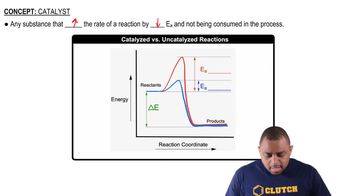
A catalyst is a substance that increases the rate of a chemical reaction without being consumed in the process. In the context of the first reaction, a catalyst is used to facilitate the formation of hydrogen cyanide from methane, ammonia, and air at high temperatures. Catalysts work by lowering the activation energy required for the reaction to occur, allowing the reaction to proceed more efficiently and at lower temperatures.
추천 영상:
가이드 코스
 01:59
01:59Catalyzed vs. Uncatalyzed Reactions
관련 실천