Ch.22 - Chemistry of the Nonmetals

Brown14th EditionChemistry: The Central ScienceISBN: 9780134414232
당신이 사용하는 게 아니라요?교과서 변경다른 교과서를 선택하세요
TOC.tableOfContents
- Ch.1 - Introduction: Matter, Energy, and Measurement177
- Ch.2 - Atoms, Molecules, and Ions231
- Ch.3 - Chemical Reactions and Reaction Stoichiometry216
- Ch.4 - Reactions in Aqueous Solution189
- Ch.5 - Thermochemistry175
- Ch.6 - Electronic Structure of Atoms168
- Ch.7 - Periodic Properties of the Elements150
- Ch.8 - Basic Concepts of Chemical Bonding177
- Ch.9 - Molecular Geometry and Bonding Theories200
- Ch.10 - Gases179
- Ch.11 - Liquids and Intermolecular Forces113
- Ch.12 - Solids and Modern Materials154
- Ch.13 - Properties of Solutions157
- Ch.14 - Chemical Kinetics199
- Ch.15 - Chemical Equilibrium128
- Ch.16 - Acid-Base Equilibria164
- Ch.17 - Additional Aspects of Aqueous Equilibria163
- Ch.18 - Chemistry of the Environment105
- Ch.19 - Chemical Thermodynamics164
- Ch.20 - Electrochemistry171
- Ch.21 - Nuclear Chemistry122
- Ch.22 - Chemistry of the Nonmetals82
- Ch.23 - Transition Metals and Coordination Chemistry79
- Ch.24 - The Chemistry of Life: Organic and Biological Chemistry16

22장, 문제 45
Complete the exercises below. Write the Lewis structure for each of the following species, and indicate the structure of each: a. SeO₃²⁻; b. S₂Cl₂; c. chlorosulfonic acid, HSO₃Cl (chlorine is bonded to sulfur).
 검증된 단계별 안내
1
Step 1: Determine the total number of valence electrons for each species. For SeO₃²⁻, calculate the valence electrons from Se and O, and add 2 for the charge. For S₂Cl₂, sum the valence electrons from S and Cl. For HSO₃Cl, sum the valence electrons from H, S, O, and Cl.
Step 2: Draw the skeletal structure for each species. For SeO₃²⁻, place Se in the center with O atoms around it. For S₂Cl₂, place the S atoms in the center with Cl atoms bonded to them. For HSO₃Cl, place S in the center with O, Cl, and H atoms bonded to it, ensuring Cl is bonded to S.
Step 3: Distribute the valence electrons around the atoms to satisfy the octet rule, starting with the outer atoms. For SeO₃²⁻, distribute electrons to the O atoms first. For S₂Cl₂, distribute electrons to the Cl atoms. For HSO₃Cl, distribute electrons to the O and Cl atoms.
Step 4: Check for formal charges and adjust the structure if necessary to minimize them. For SeO₃²⁻, consider forming double bonds between Se and O to reduce formal charges. For S₂Cl₂, ensure the formal charges are minimized. For HSO₃Cl, adjust bonds to minimize formal charges, especially around S.
Step 5: Verify that all atoms have complete octets (or duets for hydrogen) and that the total number of electrons used matches the total number of valence electrons calculated in Step 1.
주요 개념
질문에 올바르게 답하기 위해 반드시 이해해야 하는 핵심 개념들은 다음과 같습니다.
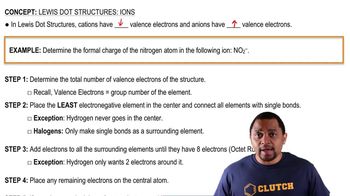
Lewis Structures
Lewis structures are diagrams that represent the bonding between atoms in a molecule and the lone pairs of electrons that may exist. They help visualize the arrangement of electrons and the connectivity of atoms, allowing chemists to predict molecular geometry and reactivity. Each dot represents a valence electron, while lines indicate covalent bonds between atoms.
추천 영상:
가이드 코스
 04:28
04:28
Lewis Dot Structures: Ions
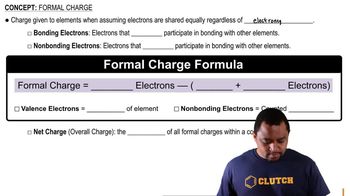
Formal Charge
Formal charge is a concept used to determine the distribution of electrons in a molecule. It is calculated by taking the number of valence electrons of an atom, subtracting the number of non-bonding electrons, and half the number of bonding electrons. This helps in assessing the most stable Lewis structure, as structures with formal charges closest to zero are generally preferred.
추천 영상:
가이드 코스
 01:53
01:53Formal Charge
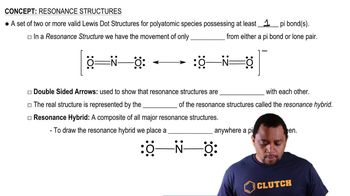
Resonance Structures
Resonance structures are different Lewis structures that represent the same molecule but differ in the arrangement of electrons. They are used when a single Lewis structure cannot accurately depict the electron distribution. The actual structure of the molecule is a hybrid of these resonance forms, which helps explain properties such as bond lengths and strengths that are intermediate between those predicted by individual structures.
추천 영상:
가이드 코스
 01:42
01:42Resonance Structures
관련 실천