
Ch.22 - Chemistry of the Nonmetals
Brown - Chemistry: The Central Science 14th Edition
Brown14th EditionChemistry: The Central ScienceISBN: 9780134414232당신이 사용하는 게 아니라요?교과서 변경
22장, 문제 35c

Explain each of the following observations:
c. The boiling point of HF is much higher than those of the other hydrogen halides.

검증된 단계별 안내
1
Identify the type of bonding and intermolecular forces present in HF and compare them with other hydrogen halides (HCl, HBr, HI).
Recognize that HF forms hydrogen bonds, which are stronger than the dipole-dipole interactions present in other hydrogen halides.
Understand that hydrogen bonding occurs when a hydrogen atom is covalently bonded to a highly electronegative atom (like fluorine) and is also attracted to another electronegative atom in a different molecule.
Consider the molecular structure and electronegativity of fluorine compared to chlorine, bromine, and iodine, which influences the strength of the hydrogen bonds in HF.
Conclude that the stronger hydrogen bonding in HF leads to higher energy requirements for molecules to escape from the liquid phase to the gas phase, resulting in a higher boiling point compared to other hydrogen halides.

비슷한 문제에 대한 검증된 영상 답변:

이 영상 해법은 위 문제에 도움이 된다고 튜터들이 추천한 것입니다.
영상 길이:
1m

주요 개념

질문에 올바르게 답하기 위해 반드시 이해해야 하는 핵심 개념들은 다음과 같습니다.

Hydrogen Bonding

Hydrogen bonding is a strong type of dipole-dipole interaction that occurs when hydrogen is bonded to highly electronegative atoms like fluorine, oxygen, or nitrogen. In HF, the hydrogen atom is attracted to the lone pair of electrons on the fluorine atom, leading to significant intermolecular forces. This results in a higher boiling point compared to other hydrogen halides, which do not exhibit such strong hydrogen bonding.
추천 영상:
가이드 코스
01:22
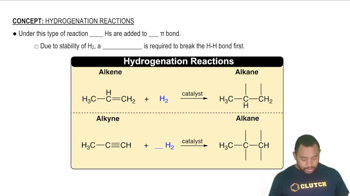
Hydrogenation Reactions

Molecular Structure and Polarity

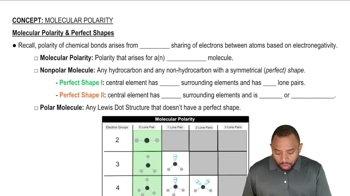
The molecular structure and polarity of a compound significantly influence its physical properties, including boiling point. HF is a polar molecule due to the large electronegativity difference between hydrogen and fluorine, which creates a dipole moment. In contrast, other hydrogen halides like HCl, HBr, and HI are less polar, resulting in weaker intermolecular forces and lower boiling points.
추천 영상:
가이드 코스
02:38
Molecular Polarity

Intermolecular Forces

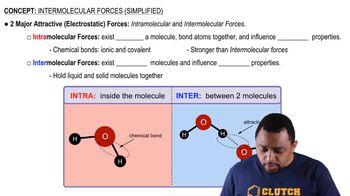
Intermolecular forces are the forces of attraction or repulsion between molecules, which play a crucial role in determining the boiling point of a substance. HF exhibits strong hydrogen bonds, while other hydrogen halides primarily rely on weaker van der Waals forces. The strength of these intermolecular forces directly correlates with the energy required to change a substance from liquid to gas, thus affecting boiling points.
추천 영상:
가이드 코스
01:59
Intermolecular vs Intramolecular Forces