Ch.22 - Chemistry of the Nonmetals

Brown14th EditionChemistry: The Central ScienceISBN: 9780134414232
당신이 사용하는 게 아니라요?교과서 변경다른 교과서를 선택하세요
TOC.tableOfContents
- Ch.1 - Introduction: Matter, Energy, and Measurement177
- Ch.2 - Atoms, Molecules, and Ions231
- Ch.3 - Chemical Reactions and Reaction Stoichiometry216
- Ch.4 - Reactions in Aqueous Solution189
- Ch.5 - Thermochemistry175
- Ch.6 - Electronic Structure of Atoms168
- Ch.7 - Periodic Properties of the Elements150
- Ch.8 - Basic Concepts of Chemical Bonding177
- Ch.9 - Molecular Geometry and Bonding Theories200
- Ch.10 - Gases179
- Ch.11 - Liquids and Intermolecular Forces113
- Ch.12 - Solids and Modern Materials154
- Ch.13 - Properties of Solutions157
- Ch.14 - Chemical Kinetics199
- Ch.15 - Chemical Equilibrium128
- Ch.16 - Acid-Base Equilibria164
- Ch.17 - Additional Aspects of Aqueous Equilibria163
- Ch.18 - Chemistry of the Environment105
- Ch.19 - Chemical Thermodynamics164
- Ch.20 - Electrochemistry171
- Ch.21 - Nuclear Chemistry122
- Ch.22 - Chemistry of the Nonmetals82
- Ch.23 - Transition Metals and Coordination Chemistry79
- Ch.24 - The Chemistry of Life: Organic and Biological Chemistry16

22장, 문제 8
Which property of the third-row nonmetallic elements might be the one depicted below:
a. first ionization energy,
b. atomic radius,
c. electronegativity,
d. melting point,
e. X―X single-bond enthalpy? [Find more in Sections 22.3, 22.4, 22.6, 22.8, and 22.10]
 검증된 단계별 안내
1
Identify the trend depicted in the data provided. Look for whether the property increases, decreases, or remains constant across the third-row nonmetallic elements.
Review the general trends for each property listed in the options across the periodic table, particularly focusing on the third-row nonmetallic elements. For example, first ionization energy generally increases across a period, atomic radius decreases, electronegativity increases, melting point varies depending on the type of element, and X―X single-bond enthalpy generally increases with the size of the atoms involved.
Match the trend you identified in step 1 with the expected trends for each property. For instance, if the property in the data increases from left to right across the third row, it could suggest a property like electronegativity or first ionization energy.
Consider any exceptions or special cases in the third row that might affect the trend, such as the presence of a metalloid or the transition from nonmetals to noble gases.
Select the property whose general trend best matches the trend depicted in the data. This will be your answer to which property might be depicted.
비슷한 문제에 대한 검증된 영상 답변:
이 영상 해법은 위 문제에 도움이 된다고 튜터들이 추천한 것입니다.

영상 길이:
2m주요 개념
질문에 올바르게 답하기 위해 반드시 이해해야 하는 핵심 개념들은 다음과 같습니다.
First Ionization Energy
First ionization energy is the energy required to remove the outermost electron from a neutral atom in its gaseous state. This property generally increases across a period due to increasing nuclear charge, which holds electrons more tightly, and decreases down a group as the distance between the nucleus and outer electrons increases, reducing the effective nuclear charge felt by those electrons.
추천 영상:
가이드 코스

 01:19
01:19
Ionization Energy
Atomic Radius
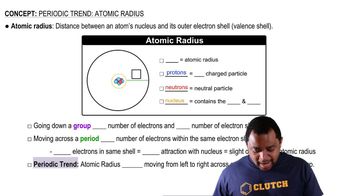
Atomic radius refers to the size of an atom, typically measured from the nucleus to the outer boundary of the surrounding cloud of electrons. Atomic radius decreases across a period due to increased nuclear charge pulling electrons closer to the nucleus, while it increases down a group as additional electron shells are added, increasing the distance between the nucleus and the outermost electrons.
추천 영상:
가이드 코스
 02:02
02:02Atomic Radius
Electronegativity
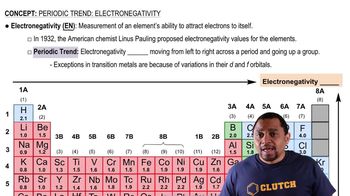
Electronegativity is a measure of an atom's ability to attract and hold onto electrons in a chemical bond. It generally increases across a period as atoms become more effective at attracting electrons due to higher nuclear charge, and decreases down a group as the increased distance from the nucleus reduces the attraction between the nucleus and bonding electrons.
추천 영상:
가이드 코스
 02:10
02:10Electronegativity Trends
관련 실천