Ch.23 - Transition Metals and Coordination Chemistry

Brown14th EditionChemistry: The Central ScienceISBN: 9780134414232
당신이 사용하는 게 아니라요?교과서 변경다른 교과서를 선택하세요
TOC.tableOfContents
- Ch.1 - Introduction: Matter, Energy, and Measurement177
- Ch.2 - Atoms, Molecules, and Ions231
- Ch.3 - Chemical Reactions and Reaction Stoichiometry216
- Ch.4 - Reactions in Aqueous Solution189
- Ch.5 - Thermochemistry175
- Ch.6 - Electronic Structure of Atoms168
- Ch.7 - Periodic Properties of the Elements150
- Ch.8 - Basic Concepts of Chemical Bonding177
- Ch.9 - Molecular Geometry and Bonding Theories200
- Ch.10 - Gases179
- Ch.11 - Liquids and Intermolecular Forces113
- Ch.12 - Solids and Modern Materials154
- Ch.13 - Properties of Solutions157
- Ch.14 - Chemical Kinetics199
- Ch.15 - Chemical Equilibrium128
- Ch.16 - Acid-Base Equilibria164
- Ch.17 - Additional Aspects of Aqueous Equilibria163
- Ch.18 - Chemistry of the Environment105
- Ch.19 - Chemical Thermodynamics164
- Ch.20 - Electrochemistry171
- Ch.21 - Nuclear Chemistry122
- Ch.22 - Chemistry of the Nonmetals82
- Ch.23 - Transition Metals and Coordination Chemistry79
- Ch.24 - The Chemistry of Life: Organic and Biological Chemistry16

23장, 문제 23
Complete the exercises below. A complex is written as NiBr₂ • 6NH₃. a. What is the oxidation state of the Ni atom in this complex? b. What is the likely coordination number for the complex? c. If the complex is treated with excess AgNO₃ (aq), how many moles of AgBr will precipitate per mole of complex?
 검증된 단계별 안내
1
Step 1: Determine the oxidation state of Ni in the complex NiBr₂ • 6NH₃. Start by recognizing that NH₃ is a neutral ligand and does not affect the oxidation state. Bromide (Br⁻) has a charge of -1. Since there are two bromide ions, their total charge is -2. Let the oxidation state of Ni be x. Set up the equation: x + 2(-1) = 0, and solve for x.
Step 2: Identify the coordination number of the complex. The coordination number is the number of ligand donor atoms bonded to the central metal ion. In this complex, there are 6 NH₃ molecules, each donating a pair of electrons to Ni. Therefore, the coordination number is the number of NH₃ ligands.
Step 3: Analyze the reaction of the complex with excess AgNO₃ (aq). AgNO₃ reacts with bromide ions to form AgBr, a precipitate. Determine how many bromide ions are present in one mole of the complex, as these will react with Ag⁺ ions to form AgBr.
Step 4: Calculate the moles of AgBr formed per mole of complex. Since each mole of complex contains 2 moles of Br⁻, and each Br⁻ reacts with one Ag⁺ to form one mole of AgBr, determine the total moles of AgBr precipitated per mole of complex.
Step 5: Summarize the findings. The oxidation state of Ni, the coordination number, and the moles of AgBr formed per mole of complex are determined based on the analysis of the complex and its reaction with AgNO₃.
주요 개념
질문에 올바르게 답하기 위해 반드시 이해해야 하는 핵심 개념들은 다음과 같습니다.
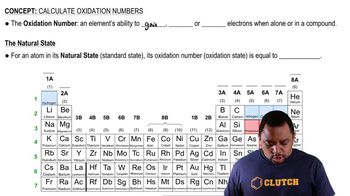
Oxidation State
The oxidation state of an element in a compound indicates the degree of oxidation of that element. It is determined by the number of electrons lost or gained compared to the neutral atom. In coordination complexes, the oxidation state can be calculated by considering the charges of the ligands and the overall charge of the complex.
추천 영상:
가이드 코스
 02:42
02:42
Oxidation Numbers
Coordination Number
The coordination number refers to the number of ligand atoms that are bonded to a central metal atom in a coordination complex. It is influenced by the size and charge of the metal ion, as well as the steric and electronic properties of the ligands. Common coordination numbers include 4 (tetrahedral) and 6 (octahedral).
추천 영상:
가이드 코스
 00:27
00:27Coordination Numbers
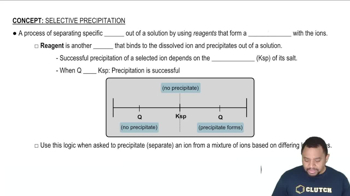
Precipitation Reaction
A precipitation reaction occurs when two soluble salts react to form an insoluble product, known as a precipitate. In this case, treating the complex with AgNO₃ leads to the formation of AgBr, which precipitates out of solution. The stoichiometry of the reaction can be used to determine the amount of precipitate formed based on the initial concentrations of the reactants.
추천 영상:
가이드 코스
 01:53
01:53Selective Precipitation
관련 실천