Ch.23 - Transition Metals and Coordination Chemistry
Brown - Chemistry: The Central Science 14th Edition
Brown14th EditionChemistry: The Central ScienceISBN: 9780134414232당신이 사용하는 게 아니라요?교과서 변경
23장, 문제 21

Complete the exercises below. a. Using Werner’s definition of valence, which property is the same as oxidation number, primary valence or secondary valence? b. What term do we normally use for the other type of valence? c. Why can NH₃ serve as a ligand but BH₃ cannot?

검증된 단계별 안내
1
Step 1: Understand Werner's Coordination Theory. Alfred Werner proposed that metal ions have two types of valences: primary and secondary. The primary valence corresponds to the oxidation state of the metal, while the secondary valence refers to the coordination number, which is the number of ligand atoms bonded to the metal ion.
Step 2: Answer part (a). According to Werner's definition, the primary valence is the same as the oxidation number. This is because the primary valence represents the charge on the metal ion, which is equivalent to its oxidation state.
Step 3: Answer part (b). The term we normally use for the secondary valence is the 'coordination number.' This refers to the number of ligand atoms that are directly bonded to the central metal ion in a coordination complex.
Step 4: Consider the properties of NH₃ and BH₃ as ligands. A ligand is a molecule or ion that can donate a pair of electrons to a metal ion to form a coordinate bond. NH₃ can serve as a ligand because it has a lone pair of electrons on the nitrogen atom that can be donated to a metal ion.
Step 5: Explain why BH₃ cannot serve as a ligand. BH₃ does not have a lone pair of electrons available for donation. In BH₃, the boron atom is electron-deficient and forms three covalent bonds with hydrogen, leaving no lone pairs to donate to a metal ion.

주요 개념

질문에 올바르게 답하기 위해 반드시 이해해야 하는 핵심 개념들은 다음과 같습니다.

Werner's Theory of Coordination Compounds

Werner's theory distinguishes between primary and secondary valences in coordination compounds. Primary valence corresponds to the oxidation state of the central metal ion, while secondary valence refers to the number of ligands attached to the metal. This framework helps in understanding the bonding and structure of complex ions.
추천 영상:
가이드 코스
01:32
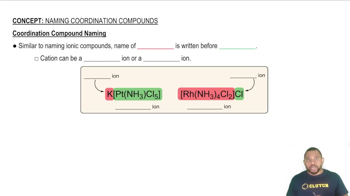
Coordination Compound Naming

Ligands and Coordination Chemistry

Ligands are molecules or ions that can donate a pair of electrons to a central metal atom to form a coordination complex. The ability of a substance to act as a ligand depends on its electron-donating capacity and steric factors. For example, NH₃ can donate a lone pair of electrons, while BH₃, being electron-deficient, cannot act as a ligand.
추천 영상:
가이드 코스
01:12
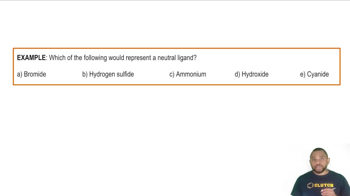
Ligands Example

Oxidation Number

The oxidation number is a concept used to indicate the degree of oxidation of an atom in a compound. It reflects the number of electrons an atom can gain, lose, or share when forming chemical bonds. In coordination chemistry, the oxidation number of the central metal ion is crucial for determining its reactivity and the overall charge of the complex.
추천 영상:
가이드 코스
02:42
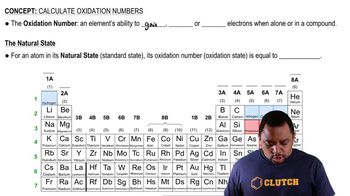
Oxidation Numbers