Ch.23 - Transition Metals and Coordination Chemistry
Brown - Chemistry: The Central Science 14th Edition
Brown14th EditionChemistry: The Central ScienceISBN: 9780134414232당신이 사용하는 게 아니라요?교과서 변경
23장, 문제 14

Among the period 4 transition metals (Sc–Zn), which elements do not form ions with partially filled 3d orbitals?

검증된 단계별 안내
1
Step 1: Understand the electronic configuration of period 4 transition metals (Sc–Zn). These elements have their 3d orbitals being filled as you move across the period.
Step 2: Recall that transition metals typically form ions by losing electrons from their outermost s and d orbitals. The 4s electrons are usually lost before the 3d electrons.
Step 3: Identify the elements that, when they form their most common ions, result in completely filled or empty 3d orbitals. This typically happens when the 3d subshell is either fully filled (d^10) or completely empty (d^0).
Step 4: Consider the common oxidation states of these elements. For example, Zn typically forms a +2 ion, resulting in a 3d^10 configuration, which is fully filled.
Step 5: Conclude which elements do not have partially filled 3d orbitals in their common ionic forms by checking their electronic configurations after ionization.

주요 개념

질문에 올바르게 답하기 위해 반드시 이해해야 하는 핵심 개념들은 다음과 같습니다.

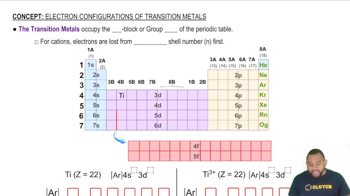
Transition Metals

Transition metals are elements found in the d-block of the periodic table, characterized by their ability to form variable oxidation states and colored compounds. They typically have partially filled d orbitals, which play a crucial role in their chemical properties and reactivity. In period 4, these metals include Scandium (Sc) to Zinc (Zn), each exhibiting unique behaviors based on their electron configurations.
추천 영상:
가이드 코스
03:12
Transition Metals

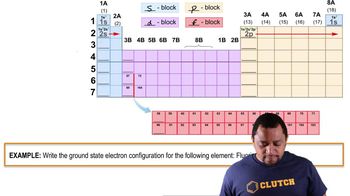
Electron Configuration

Electron configuration describes the distribution of electrons in an atom's orbitals. For transition metals, the 3d and 4s orbitals are particularly important. Understanding the electron configuration helps determine which elements can lose electrons to form ions, especially those with partially filled d orbitals, which are essential for the formation of various oxidation states.
추천 영상:
가이드 코스
01:33
Electron Configuration Example

Ionic vs. Neutral States

Ionic states refer to the charged forms of elements that result from the loss or gain of electrons, while neutral states have no net charge. Transition metals can exist in multiple ionic states, depending on their electron configurations. Elements that do not form ions with partially filled 3d orbitals typically have either fully filled or empty d orbitals, limiting their ability to lose electrons and form stable ions.
추천 영상: