Ch.23 - Transition Metals and Coordination Chemistry

Brown14th EditionChemistry: The Central ScienceISBN: 9780134414232
당신이 사용하는 게 아니라요?교과서 변경다른 교과서를 선택하세요
TOC.tableOfContents
- Ch.1 - Introduction: Matter, Energy, and Measurement177
- Ch.2 - Atoms, Molecules, and Ions231
- Ch.3 - Chemical Reactions and Reaction Stoichiometry216
- Ch.4 - Reactions in Aqueous Solution189
- Ch.5 - Thermochemistry175
- Ch.6 - Electronic Structure of Atoms168
- Ch.7 - Periodic Properties of the Elements150
- Ch.8 - Basic Concepts of Chemical Bonding177
- Ch.9 - Molecular Geometry and Bonding Theories200
- Ch.10 - Gases179
- Ch.11 - Liquids and Intermolecular Forces113
- Ch.12 - Solids and Modern Materials154
- Ch.13 - Properties of Solutions157
- Ch.14 - Chemical Kinetics199
- Ch.15 - Chemical Equilibrium128
- Ch.16 - Acid-Base Equilibria164
- Ch.17 - Additional Aspects of Aqueous Equilibria163
- Ch.18 - Chemistry of the Environment105
- Ch.19 - Chemical Thermodynamics164
- Ch.20 - Electrochemistry171
- Ch.21 - Nuclear Chemistry122
- Ch.22 - Chemistry of the Nonmetals82
- Ch.23 - Transition Metals and Coordination Chemistry79
- Ch.24 - The Chemistry of Life: Organic and Biological Chemistry16

23장, 문제 43
Complete the exercises below. Determine if each of the following complexes exhibits geometric isomerism. If geometric isomers exist, determine how many there are. c. octahedral [Fe(o-phen)₂ Cl₂]⁺.
 검증된 단계별 안내
1
Step 1: Understand the structure of the complex. The complex [Fe(o-phen)₂Cl₂]⁺ is an octahedral complex where 'o-phen' stands for 1,10-phenanthroline, a bidentate ligand, and there are two chloride ions as ligands.
Step 2: Identify the coordination number and geometry. The coordination number for this complex is 6, which is typical for octahedral complexes. The ligands are arranged around the central metal ion, Fe, in an octahedral geometry.
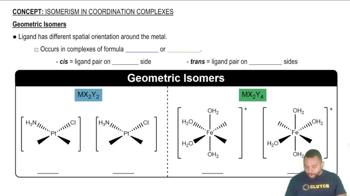
Step 3: Consider the arrangement of ligands. In an octahedral complex, geometric isomerism can occur if there are different types of ligands. Here, we have two bidentate o-phen ligands and two monodentate Cl⁻ ligands.
Step 4: Determine possible isomers. For octahedral complexes with the formula [M(A₂B₂)], where A and B are different ligands, geometric isomers can exist as 'cis' (adjacent) and 'trans' (opposite) forms. Apply this to [Fe(o-phen)₂Cl₂]⁺.
Step 5: Count the isomers. In this case, the complex can have two geometric isomers: one where the two Cl⁻ ligands are adjacent (cis) and one where they are opposite each other (trans).
주요 개념
질문에 올바르게 답하기 위해 반드시 이해해야 하는 핵심 개념들은 다음과 같습니다.
Geometric Isomerism
Geometric isomerism occurs when compounds have the same molecular formula and connectivity of atoms but differ in the spatial arrangement of those atoms. This type of isomerism is particularly relevant in coordination complexes, where ligands can occupy different positions around a central metal ion, leading to distinct isomers with different properties.
추천 영상:
가이드 코스
 02:02
02:02
Geometric Isomers
Octahedral Coordination Complexes
Octahedral coordination complexes consist of a central metal ion surrounded by six ligands arranged at the corners of an octahedron. The geometry allows for various ligand arrangements, which can lead to the formation of geometric isomers, such as cis and trans isomers, depending on the relative positions of the ligands.
추천 영상:
가이드 코스
 00:43
00:43Coordination Complexes Example
Ligand Types and Their Influence
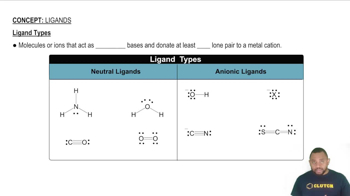
The type of ligands attached to a metal center can significantly influence the possibility of geometric isomerism. Bidentate ligands, like o-phenanthroline (o-phen), can create more complex arrangements compared to monodentate ligands, affecting the number and types of isomers that can form in octahedral complexes.
추천 영상:
가이드 코스
 02:38
02:38Ligand Types
관련 실천