Ch.23 - Transition Metals and Coordination Chemistry
Brown - Chemistry: The Central Science 14th Edition
Brown14th EditionChemistry: The Central ScienceISBN: 9780134414232당신이 사용하는 게 아니라요?교과서 변경
23장, 문제 64a,b

Complete the exercises below. Draw the crystal-field energy-level diagrams and show the placement of electrons for each of the following complexes: 
a. [VCl6]3–,
b. [FeF6]3– (a high-spin complex),

검증된 단계별 안내
1
Identify the metal ion and its oxidation state in each complex. For [VCl6]3–, vanadium (V) is the metal, and for [FeF6]3–, iron (Fe) is the metal. Determine the oxidation state by considering the charge of the complex and the known charges of the ligands (Cl- and F-).
Determine the electron configuration of the metal ion in its oxidation state. For example, V3+ and Fe3+ have specific electron configurations that can be derived from their neutral atom configurations by removing electrons from the outermost orbitals.
Consider the geometry of the complex. Both [VCl6]3– and [FeF6]3– are octahedral complexes, which means the d-orbitals will split into two sets: t2g (lower energy) and eg (higher energy) due to the crystal field splitting.
For [VCl6]3–, place the electrons in the crystal-field energy-level diagram according to the electron configuration of V3+. Since Cl- is a weak field ligand, the splitting will be small, and electrons will fill the t2g and eg orbitals according to Hund's rule.
For [FeF6]3–, determine the placement of electrons in the crystal-field energy-level diagram for Fe3+. As a high-spin complex with F- as a weak field ligand, the electrons will occupy the orbitals to maximize unpaired electrons, following Hund's rule and the small splitting energy.

비슷한 문제에 대한 검증된 영상 답변:

이 영상 해법은 위 문제에 도움이 된다고 튜터들이 추천한 것입니다.

주요 개념

질문에 올바르게 답하기 위해 반드시 이해해야 하는 핵심 개념들은 다음과 같습니다.

Crystal Field Theory

Crystal Field Theory (CFT) explains the electronic structure of transition metal complexes by considering the effect of surrounding ligands on the d-orbitals of the metal ion. It describes how the degeneracy of d-orbitals is lifted due to the electrostatic interactions between the metal ion and the ligands, leading to different energy levels. This theory is essential for understanding the color, magnetism, and stability of coordination compounds.
추천 영상:
가이드 코스
01:18
The study of ligand-metal interactions helped to form Ligand Field Theory which combines CFT with MO Theory.

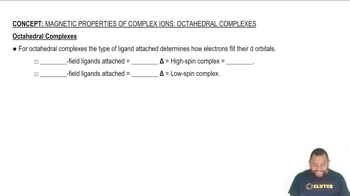
High-Spin vs. Low-Spin Complexes

High-spin and low-spin complexes refer to the arrangement of electrons in the d-orbitals of transition metals in the presence of ligands. High-spin complexes have unpaired electrons due to weaker field ligands, resulting in a higher total spin state, while low-spin complexes have paired electrons due to stronger field ligands, leading to a lower total spin state. The distinction is crucial for predicting magnetic properties and the geometry of the complexes.
추천 영상:
가이드 코스
01:28
For octahedral complexes, Weak-Field Ligands create High-spin complexes and Strong-Field Ligands create Low-spin complexes.

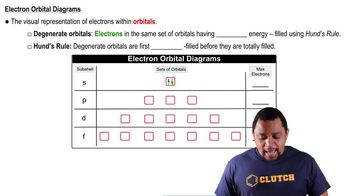
Electron Configuration and Orbital Diagrams

Understanding electron configuration and orbital diagrams is vital for determining how electrons are distributed among the available d-orbitals in transition metal complexes. The placement of electrons follows the Aufbau principle, Hund's rule, and the Pauli exclusion principle, which dictate the order of filling and the arrangement of electrons. This knowledge is necessary for accurately drawing crystal-field energy-level diagrams and predicting the behavior of the complexes.
추천 영상:
가이드 코스
02:15
Electron Orbital Diagrams