Ch.23 - Transition Metals and Coordination Chemistry
Brown - Chemistry: The Central Science 14th Edition
Brown14th EditionChemistry: The Central ScienceISBN: 9780134414232당신이 사용하는 게 아니라요?교과서 변경
23장, 문제 52a

The lobes of which d orbitals point directly between the ligands in a. octahedral geometry,

검증된 단계별 안내
1
Identify the orientation of ligands in an octahedral geometry. In this geometry, ligands are positioned along the x, y, and z axes, directly opposite each other.
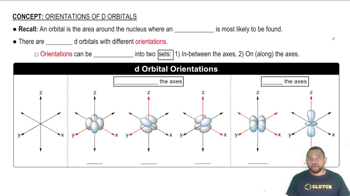
Understand the orientation of d orbitals. There are five d orbitals: \(d_{xy}\), \(d_{xz}\), \(d_{yz}\), \(d_{x^2-y^2}\), and \(d_{z^2}\). Each of these orbitals has a unique shape and orientation in 3D space.
Analyze the orientation of each d orbital relative to the ligand positions in an octahedral complex. The \(d_{x^2-y^2}\) and \(d_{z^2}\) orbitals point directly along the x and y axes, or along the z-axis, respectively.
Determine which d orbitals point directly between the ligands. In an octahedral geometry, the \(d_{xy}\), \(d_{xz}\), and \(d_{yz}\) orbitals are oriented between the axes, not directly along or towards any ligands.
Conclude that the \(d_{xy}\), \(d_{xz}\), and \(d_{yz}\) orbitals are the ones whose lobes point directly between the ligands in an octahedral geometry.

비슷한 문제에 대한 검증된 영상 답변:

이 영상 해법은 위 문제에 도움이 된다고 튜터들이 추천한 것입니다.
영상 길이:
2m
도움이 되었나요?

주요 개념

질문에 올바르게 답하기 위해 반드시 이해해야 하는 핵심 개념들은 다음과 같습니다.

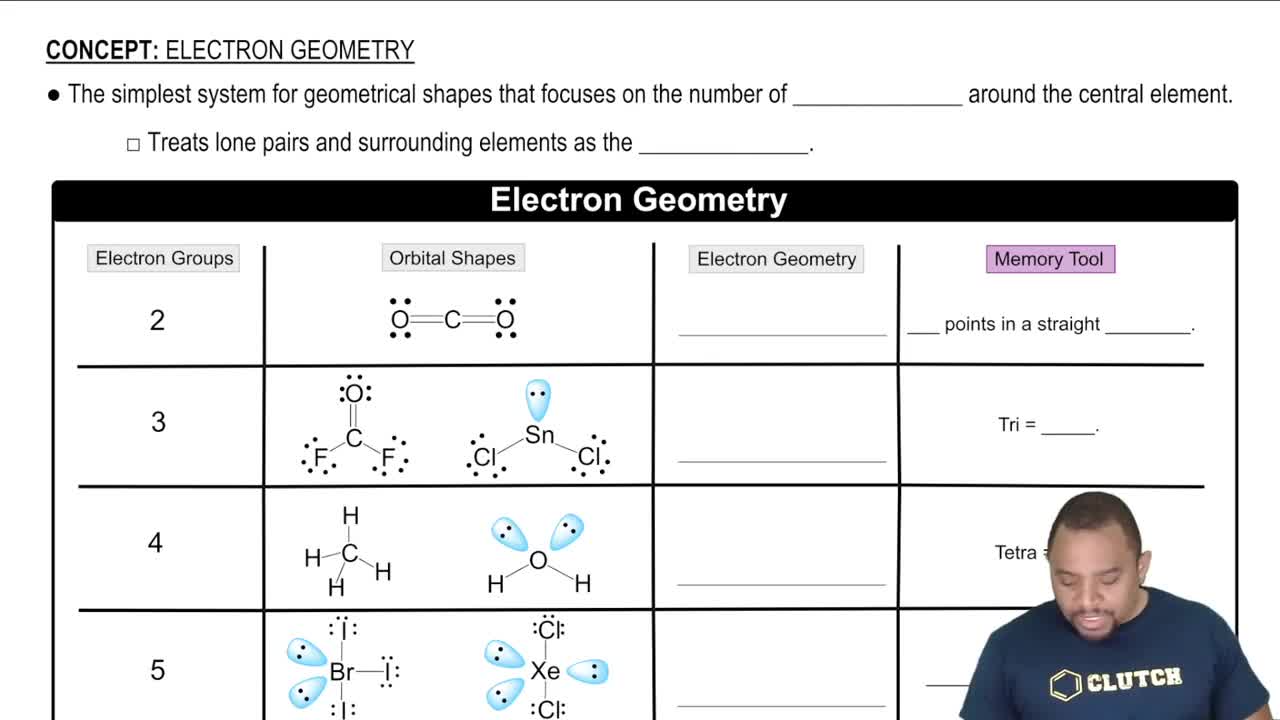
Octahedral Geometry

Octahedral geometry is a molecular shape where a central atom is surrounded by six ligands positioned at the vertices of an octahedron. This arrangement allows for optimal spatial distribution of the ligands, minimizing repulsion between them. In this geometry, the bond angles between the ligands are 90 degrees, which is crucial for understanding the spatial orientation of d orbitals.
추천 영상:
가이드 코스
04:44
Electron Geometry

d Orbitals

d orbitals are a set of five orbitals in the electron configuration of transition metals, designated as dxy, dyz, dzx, dx2-y2, and dz2. These orbitals have distinct shapes and orientations, influencing how transition metals interact with ligands. In octahedral complexes, the d orbitals split into two energy levels due to ligand field theory, affecting the electronic properties and reactivity of the metal center.
추천 영상:
가이드 코스
02:06
d Orbital Orientations

Ligand Field Theory

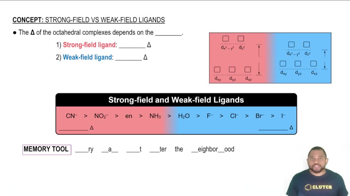
Ligand field theory explains the interaction between transition metal ions and surrounding ligands, focusing on how the presence of ligands affects the energy levels of the metal's d orbitals. In octahedral complexes, the ligands cause the d orbitals to split into two groups: the lower-energy t2g orbitals and the higher-energy eg orbitals. This splitting is essential for predicting the electronic configuration, color, and magnetic properties of the complex.
추천 영상:
가이드 코스
02:40
Strong-Field Ligands result in a large Δ and Weak-Field Ligands result in a small Δ.