
Ch.23 - Transition Metals and Coordination Chemistry
Brown - Chemistry: The Central Science 14th Edition
Brown14th EditionChemistry: The Central ScienceISBN: 9780134414232당신이 사용하는 게 아니라요?교과서 변경
23장, 문제 71c

Sketch the structure of the complex in each of the following compounds and give the full compound name:
c. trans-NH3[Co(C2O4)2(H2O)2]

검증된 단계별 안내
1
Identify the central metal atom in the complex, which in this case is Cobalt (Co).
Recognize the ligands attached to the central metal. Here, the ligands are ammonia (NH3), oxalate (C2O4)2-, and water (H2O).
Determine the geometry of the complex. Cobalt typically forms octahedral complexes, meaning six ligands are symmetrically arranged around the cobalt.
Arrange the ligands in a trans configuration as specified. In a trans configuration, similar ligands are opposite each other. Place the two ammonia ligands opposite each other, and the two water molecules opposite each other, with the oxalate ligands occupying the remaining positions.
Write the full name of the compound: trans-diamminediaquabis(oxalato)cobalt(III).

비슷한 문제에 대한 검증된 영상 답변:

이 영상 해법은 위 문제에 도움이 된다고 튜터들이 추천한 것입니다.
영상 길이:
10m

주요 개념

질문에 올바르게 답하기 위해 반드시 이해해야 하는 핵심 개념들은 다음과 같습니다.

Coordination Compounds

Coordination compounds consist of a central metal atom or ion bonded to surrounding molecules or ions known as ligands. The arrangement and types of ligands influence the properties and reactivity of the complex. Understanding the nature of these interactions is crucial for sketching the structure of coordination complexes.
추천 영상:
가이드 코스
01:32
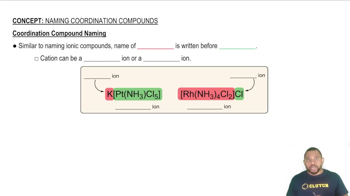
Coordination Compound Naming

Ligands

Ligands are ions or molecules that can donate a pair of electrons to a central metal atom to form a coordinate bond. They can be classified as monodentate, bidentate, or polydentate based on the number of donor atoms they possess. In the given compound, oxalate (C2O4) acts as a bidentate ligand, coordinating through two oxygen atoms.
추천 영상:
가이드 코스
01:12
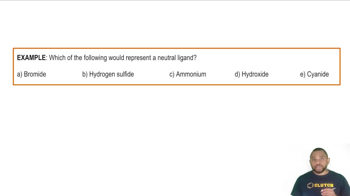
Ligands Example

Geometric Isomerism

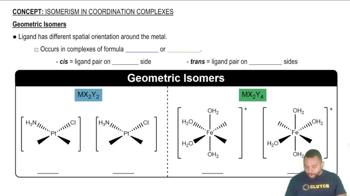
Geometric isomerism occurs in coordination compounds when ligands can be arranged differently around the central metal atom, leading to distinct spatial configurations. In the case of the given compound, the 'trans' designation indicates that the ligands are positioned opposite each other, which affects the compound's properties and reactivity.
추천 영상:
가이드 코스
02:02
Geometric Isomers