Ch.24 - The Chemistry of Life: Organic and Biological Chemistry
Brown - Chemistry: The Central Science 14th Edition
Brown14th EditionChemistry: The Central ScienceISBN: 9780134414232당신이 사용하는 게 아니라요?교과서 변경
24장, 문제 51b

Write a balanced chemical equation using condensed structural formulas for the saponification (base hydrolysis) of
b. phenyl acetate.

검증된 단계별 안내
1
Identify the structure of phenyl acetate, which is an ester formed from acetic acid and phenol. The condensed structural formula for phenyl acetate is C6H5OCOCH3.
Recognize that saponification involves the reaction of an ester with a strong base (commonly NaOH) to form an alcohol and a carboxylate salt.
Write the chemical formula for the base, NaOH, which will be used to hydrolyze the ester.
Set up the reaction: phenyl acetate (C6H5OCOCH3) reacts with NaOH. The ester bond in phenyl acetate will be broken, forming phenol (C6H5OH) and sodium acetate (CH3COONa).
Balance the chemical equation to ensure the number of atoms for each element is the same on both sides of the equation. The balanced equation should reflect a 1:1 molar ratio between phenyl acetate and NaOH.

비슷한 문제에 대한 검증된 영상 답변:

이 영상 해법은 위 문제에 도움이 된다고 튜터들이 추천한 것입니다.
영상 길이:
4m

주요 개념

질문에 올바르게 답하기 위해 반드시 이해해야 하는 핵심 개념들은 다음과 같습니다.

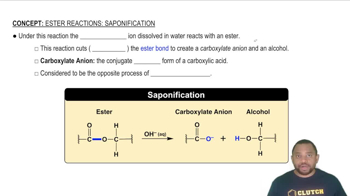
Saponification

Saponification is a chemical reaction that involves the hydrolysis of an ester in the presence of a base, typically sodium hydroxide (NaOH) or potassium hydroxide (KOH). This process produces an alcohol and a carboxylate salt, which is commonly known as soap. In the context of phenyl acetate, saponification results in the formation of phenol and sodium acetate.
추천 영상:
가이드 코스
01:25
Ester Reactions: Saponification

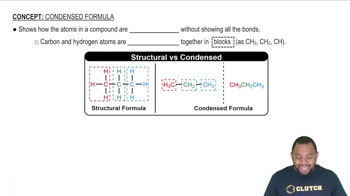
Condensed Structural Formulas

Condensed structural formulas provide a simplified representation of a molecule's structure, showing the arrangement of atoms and the connectivity between them without depicting all the bonds explicitly. This notation is useful for illustrating the reactants and products in a chemical reaction, allowing chemists to quickly understand the molecular composition and relationships in the reaction.
추천 영상:
가이드 코스
01:53
Condensed Formula

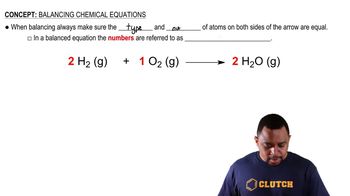
Balancing Chemical Equations

Balancing chemical equations is the process of ensuring that the number of atoms for each element is the same on both the reactant and product sides of the equation. This is based on the law of conservation of mass, which states that matter cannot be created or destroyed in a chemical reaction. A balanced equation accurately reflects the stoichiometry of the reaction, allowing for the correct prediction of product yields and reactant consumption.
추천 영상:
가이드 코스
01:32
Balancing Chemical Equations