Balance the following equations: (c) Ba3N2(s) + H2O(aq) → Ba(OH)2(aq) + NH3(g)
Ch.3 - Chemical Reactions and Reaction Stoichiometry
3장, 문제 12a,b
Balance the following equations:
(a) HClO4(aq) + P4O10(s) → HPO3(aq) + Cl2O7(l)
(b) Au2S3(s + H2(g) → Au(s) + H2S(g)
검증된 단계별 안내1
Step 1: Identify the reactants and the products in the chemical equation. In this case, the reactants are Au2S3 and H2, and the products are Au and H2S.
Step 2: Balance the equation for one type of atom at a time. Start with the atom that appears in the greatest number of compounds on either side of the equation. In this case, start with Au. There are 2 Au atoms on the reactant side and 1 Au atom on the product side. To balance this, place a coefficient of 2 in front of Au on the product side.
Step 3: Next, balance the S atoms. There are 3 S atoms on the reactant side and 1 S atom on the product side in H2S. To balance this, place a coefficient of 3 in front of H2S on the product side.
Step 4: Finally, balance the H atoms. There are 2 H atoms on the reactant side and 6 H atoms on the product side (3 H2S molecules each with 2 H atoms). To balance this, place a coefficient of 3 in front of H2 on the reactant side.
Step 5: Check your work. The final balanced equation should have the same number of each type of atom on both sides of the equation. If it does not, go back and adjust the coefficients until it does.

비슷한 문제에 대한 검증된 영상 답변:
이 영상 해법은 위 문제에 도움이 된다고 튜터들이 추천한 것입니다.
영상 길이:
1m주요 개념
질문에 올바르게 답하기 위해 반드시 이해해야 하는 핵심 개념들은 다음과 같습니다.
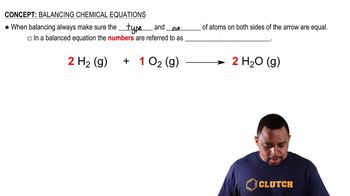
Balancing Chemical Equations
Balancing chemical equations involves ensuring that the number of atoms for each element is the same on both sides of the equation. This is based on the law of conservation of mass, which states that matter cannot be created or destroyed in a chemical reaction. Coefficients are used to adjust the number of molecules or formula units to achieve balance.
추천 영상:
가이드 코스
Balancing Chemical Equations
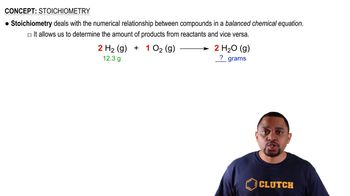
Stoichiometry
Stoichiometry is the quantitative relationship between reactants and products in a chemical reaction. It allows chemists to predict the amounts of substances consumed and produced in a reaction. Understanding stoichiometry is essential for balancing equations, as it provides the ratios needed to ensure that all atoms are accounted for.
추천 영상:
가이드 코스
Stoichiometry Concept
Types of Chemical Reactions
Chemical reactions can be classified into several types, including synthesis, decomposition, single replacement, and double replacement. Recognizing the type of reaction can help in predicting the products and understanding how to balance the equation. In the given equation, the reaction involves the formation of gold and hydrogen sulfide from gold sulfide and hydrogen, indicating a type of synthesis or decomposition reaction.
추천 영상:
가이드 코스
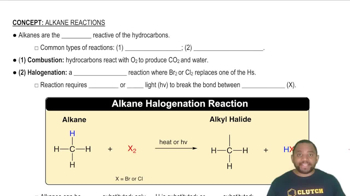
Common Types of Alkane Reactions
관련 실천
교과서 질문
466
views
교과서 질문
A key step in balancing chemical equations is correctly identifying the formulas of the reactants and products. For example, consider the reaction between calcium oxide, CaO(s), and H2O1l2 to form aqueous calcium hydroxide. (b) Is it possible to balance the equation if you incorrectly identify the product as CaOH1aq2, and if so, what is the equation?
1126
views
교과서 질문
Balance the following equations:
(a) CaS(s) + H2O(l) → Ca(HS2)2(aq) + Ca(OH)2(aq)
(b) NH3(g) + O2(g) → NO(g) + H2O(g)
(c) FeCl3(s) + Na2CO3(aq) → Fe2(CO3)3(s) + NaCl(aq)
(d) FeS2(s) + O2(g) → Fe2O3(s) + SO2(g)
520
views
교과서 질문
Balance the following equations: (d) Na2CO3(aq) + HCl(aq) → NaCl(aq) + H2O(l) + CO2(g)
371
views
교과서 질문
Balance the following equations: (c) Al(OH)3(s) + H2SO4(l) → Al2(SO4)3(s) + H2O(l)
725
views