What is the molecular formula of each of the following compounds? (a) empirical formula CH, molar mass 5 78.0 g/mol (b) empirical formula NH2Cl, molar mass = 51.5 g/mol
Ch.3 - Chemical Reactions and Reaction Stoichiometry
3장, 문제 48c
Determine the empirical formulas of the compounds with the following compositions by mass: (c) 60.0% C, 4.4% H, and the remainder O
검증된 단계별 안내1
Identify the mass percentages of each element: 60.0% C, 4.4% H, and the remainder O. Calculate the percentage of O by subtracting the sum of the percentages of C and H from 100%.
Assume a 100 g sample of the compound, which means you have 60.0 g of C, 4.4 g of H, and the remainder in grams of O.
Convert the masses of each element to moles by dividing by their respective atomic masses: C (12.01 g/mol), H (1.008 g/mol), and O (16.00 g/mol).
Determine the mole ratio of the elements by dividing each element's mole value by the smallest number of moles calculated in the previous step.
If necessary, multiply the mole ratios by a whole number to obtain the smallest whole number ratio for the empirical formula.

비슷한 문제에 대한 검증된 영상 답변:
이 영상 해법은 위 문제에 도움이 된다고 튜터들이 추천한 것입니다.
영상 길이:
1m주요 개념
질문에 올바르게 답하기 위해 반드시 이해해야 하는 핵심 개념들은 다음과 같습니다.
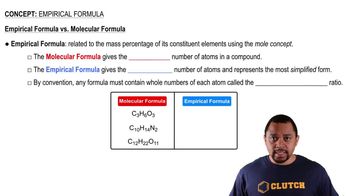
Empirical Formula
The empirical formula of a compound represents the simplest whole-number ratio of the elements present in that compound. It is derived from the mass percentages of each element, which are converted to moles and then simplified to the smallest integer ratio. This formula provides essential information about the composition of the compound without indicating the actual number of atoms in a molecule.
추천 영상:
가이드 코스
Empirical vs Molecular Formula
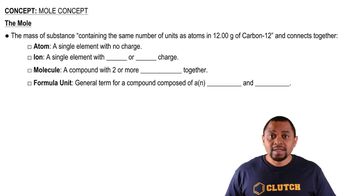
Mole Concept
The mole concept is a fundamental principle in chemistry that relates the mass of a substance to the number of particles it contains. One mole of any substance contains Avogadro's number (approximately 6.022 x 10²³) of entities, whether they are atoms, molecules, or ions. This concept is crucial for converting mass percentages into moles, which is necessary for determining the empirical formula.
추천 영상:
가이드 코스
Mole Concept
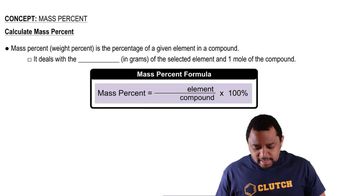
Mass Percent Composition
Mass percent composition refers to the percentage by mass of each element in a compound. It is calculated by dividing the mass of each element in a sample by the total mass of the sample and multiplying by 100. Understanding mass percent composition is essential for converting the given percentages into moles, which is the first step in finding the empirical formula of a compound.
추천 영상:
가이드 코스
Mass Percent Calculation
관련 실천
교과서 질문
870
views
교과서 질문
The compound XCl4 contains 75.0% Cl by mass. What is the element X?
1449
views
교과서 질문
Determine the empirical formulas of the compounds with the following compositions by mass: (b) 57.5% Na, 40.0% O, and 2.5% H (c) 41.1% N, 11.8% H, and the remainder S
723
views
교과서 질문
Determine the empirical formulas of the compounds with the following compositions by mass: (a) 74.0% C, 8.7% H, and 17.3% N
501
views
교과서 질문
A compound whose empirical formula is XF3 consists of 65% F by mass. What is the atomic mass of X?
2720
views
교과서 질문
Determine the empirical formulas of the compounds with the following compositions by mass: (a) 42.1% Na, 18.9% P, and 39.0% O (b) 18.7% Li, 16.3% C, and 65.0% O
1243
views