Ch.3 - Chemical Reactions and Reaction Stoichiometry
Brown - Chemistry: The Central Science 14th Edition
Brown14th EditionChemistry: The Central ScienceISBN: 9780134414232당신이 사용하는 게 아니라요?교과서 변경
3장, 문제 77c

Sodium hydroxide reacts with carbon dioxide as follows: 2 NaOH1s2 + CO21g2¡Na2CO31s2 + H2O1l2 How many moles of the excess reactant remain after the completion of the reaction?

검증된 단계별 안내
1
Step 1: Identify the limiting reactant. This is the reactant that will be completely consumed in the reaction. To do this, you need to know the initial amounts of both reactants and compare their mole ratios. The reactant that has fewer moles than required by the stoichiometry of the reaction is the limiting reactant.
Step 2: Calculate the amount of the other reactant that would be consumed if all of the limiting reactant were used up. This is done by using the stoichiometric ratios from the balanced chemical equation.
Step 3: Subtract the amount of the other reactant that would be consumed from its initial amount. This will give you the amount of the excess reactant that remains after the reaction is complete.
Step 4: If the problem provides specific quantities for the reactants, use these values to perform the calculations in steps 1-3. If not, you cannot determine the exact amount of excess reactant remaining without more information.
Step 5: Remember to express your answer in moles, as the question asks for the amount of excess reactant remaining in moles.

비슷한 문제에 대한 검증된 영상 답변:

이 영상 해법은 위 문제에 도움이 된다고 튜터들이 추천한 것입니다.
영상 길이:
1m

주요 개념

질문에 올바르게 답하기 위해 반드시 이해해야 하는 핵심 개념들은 다음과 같습니다.

Stoichiometry

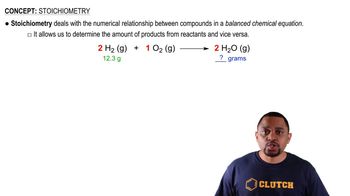
Stoichiometry is the calculation of reactants and products in chemical reactions based on the balanced chemical equation. It allows us to determine the proportions of substances involved in a reaction, which is essential for predicting how much of each reactant is consumed and how much product is formed.
추천 영상:
가이드 코스
01:16
Stoichiometry Concept

Limiting Reactant

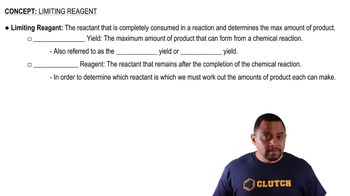
The limiting reactant is the substance that is completely consumed first in a chemical reaction, thus determining the maximum amount of product that can be formed. Identifying the limiting reactant is crucial for calculating the amounts of excess reactants remaining after the reaction has occurred.
추천 영상:
가이드 코스
01:30
Limiting Reagent Concept

Mole Concept

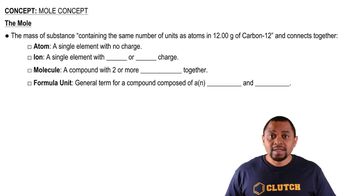
The mole concept is a fundamental principle in chemistry that relates the mass of a substance to the number of particles it contains. One mole of any substance contains Avogadro's number (approximately 6.022 x 10²³) of entities, allowing chemists to convert between grams and moles, which is essential for stoichiometric calculations.
추천 영상: