
Ch.3 - Chemical Reactions and Reaction Stoichiometry
Brown - Chemistry: The Central Science 14th Edition
Brown14th EditionChemistry: The Central ScienceISBN: 9780134414232당신이 사용하는 게 아니라요?교과서 변경
3장, 문제 2a

The following diagram shows the combination reaction between hydrogen, H2, and carbon monoxide, CO, to produce methanol, CH3OH (white spheres are H, black spheres are C, red spheres are O). The correct number of CO molecules involved in this reaction is not shown. (a) Determine the number of CO molecules that should be shown in the left (reactants) box.

검증된 단계별 안내
1
Identify the chemical formula for each reactant and product. For this reaction, the reactants are hydrogen (H2) and carbon monoxide (CO), and the product is methanol (CH3OH).
Write the unbalanced chemical equation for the reaction: H2 + CO → CH3OH.
Balance the equation by adjusting the coefficients to ensure that the number of atoms for each element is the same on both sides of the equation. Start by balancing the carbon (C) atoms, then the hydrogen (H) atoms, and finally the oxygen (O) atoms.
Verify that the total number of atoms of each type on the left side of the equation equals the total number on the right side. This confirms that the equation is balanced.
Count the number of CO molecules (represented by the coefficient in front of CO in the balanced equation) to determine how many should be shown in the reactants box.

비슷한 문제에 대한 검증된 영상 답변:

이 영상 해법은 위 문제에 도움이 된다고 튜터들이 추천한 것입니다.
영상 길이:
1m

주요 개념

질문에 올바르게 답하기 위해 반드시 이해해야 하는 핵심 개념들은 다음과 같습니다.

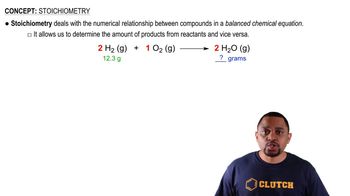
Stoichiometry

Stoichiometry is the branch of chemistry that deals with the quantitative relationships between the reactants and products in a chemical reaction. It allows chemists to calculate the amounts of substances consumed and produced in a reaction based on balanced chemical equations. Understanding stoichiometry is essential for determining how many molecules of each reactant are needed to produce a specific amount of product.
추천 영상:
가이드 코스
01:16
Stoichiometry Concept

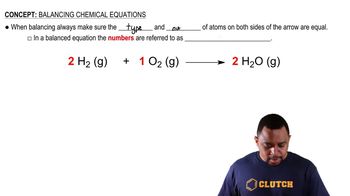
Balanced Chemical Equation

A balanced chemical equation represents a chemical reaction with equal numbers of each type of atom on both sides of the equation. This balance reflects the law of conservation of mass, which states that matter cannot be created or destroyed in a chemical reaction. For the reaction between hydrogen and carbon monoxide to form methanol, the balanced equation is crucial for identifying the correct stoichiometric coefficients for each reactant and product.
추천 영상:
가이드 코스
01:32
Balancing Chemical Equations

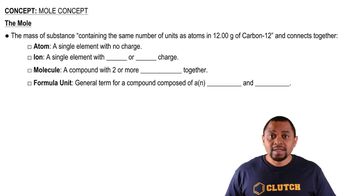
Mole Concept

The mole concept is a fundamental principle in chemistry that relates the mass of a substance to the number of particles it contains. One mole of any substance contains Avogadro's number (approximately 6.022 x 10^23) of molecules. This concept is vital for converting between grams and moles, allowing chemists to determine how many molecules of carbon monoxide are needed to react with a given amount of hydrogen to produce methanol.
추천 영상: