
Ch.3 - Chemical Reactions and Reaction Stoichiometry
Brown - Chemistry: The Central Science 14th Edition
Brown14th EditionChemistry: The Central ScienceISBN: 9780134414232당신이 사용하는 게 아니라요?교과서 변경
3장, 문제 107

Viridicatumtoxin B, C30H31NO10, is a natural antibiotic compound. It requires a synthesis of 12 steps in the laboratory. Assuming all steps have equivalent yields of 85%, which is the final percent yield of the total synthesis?

검증된 단계별 안내
1
Identify that the problem involves calculating the overall percent yield of a multi-step synthesis, where each step has an equivalent yield of 85%.
Recall that the overall yield of a multi-step process is the product of the yields of each individual step.
Express the yield of each step as a decimal: 85% becomes 0.85.
Since there are 12 steps, raise the yield of one step to the power of 12: \((0.85)^{12}\).
Convert the result back to a percentage by multiplying by 100 to find the final percent yield of the total synthesis.

비슷한 문제에 대한 검증된 영상 답변:

이 영상 해법은 위 문제에 도움이 된다고 튜터들이 추천한 것입니다.
영상 길이:
51s
도움이 되었나요?

주요 개념

질문에 올바르게 답하기 위해 반드시 이해해야 하는 핵심 개념들은 다음과 같습니다.

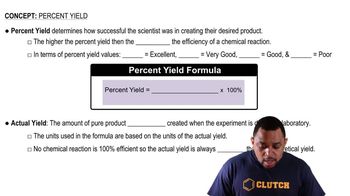
Percent Yield

Percent yield is a measure of the efficiency of a chemical reaction, calculated as the ratio of the actual yield to the theoretical yield, multiplied by 100. It indicates how much product is obtained from a reaction compared to the maximum possible amount, helping chemists assess the effectiveness of their synthetic processes.
추천 영상:
가이드 코스
03:09
Percent Yield in Reactions

Sequential Reactions

In synthetic chemistry, sequential reactions refer to a series of chemical transformations where the product of one reaction serves as the reactant for the next. Each step can affect the overall yield, as the final product yield is influenced by the yields of all preceding steps, necessitating careful calculation of cumulative effects.
추천 영상:
가이드 코스
01:30
Alcohol Reactions: Dehydration Reactions

Multiplicative Yield Calculation

When dealing with multiple steps in a synthesis, the overall yield is calculated by multiplying the yields of each individual step. For example, if each step has a yield of 85%, the final yield is determined by raising the yield to the power of the number of steps, reflecting the compounding effect of losses at each stage.
추천 영상:
가이드 코스
03:09
Percent Yield in Reactions