
Ch.3 - Chemical Reactions and Reaction Stoichiometry
Brown - Chemistry: The Central Science 14th Edition
Brown14th EditionChemistry: The Central ScienceISBN: 9780134414232당신이 사용하는 게 아니라요?교과서 변경
3장, 문제 9a

Write 'true' or 'false' for each statement. (a) We balance chemical equations as we do because energy must be conserved.

검증된 단계별 안내
1
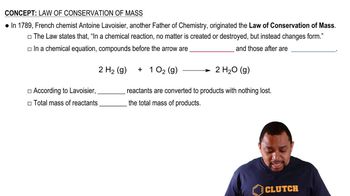
Understand the law of conservation of mass, which states that mass is neither created nor destroyed in a chemical reaction.
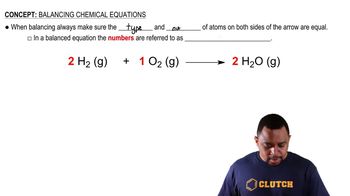
Recognize that balancing chemical equations ensures that the same number of each type of atom is present on both sides of the equation.
Note that energy conservation is a separate concept, related to the first law of thermodynamics, which states that energy cannot be created or destroyed.
Identify that balancing chemical equations is primarily about conserving mass, not energy.
Conclude that the statement is false because balancing equations is about conserving mass, not energy.

비슷한 문제에 대한 검증된 영상 답변:

이 영상 해법은 위 문제에 도움이 된다고 튜터들이 추천한 것입니다.
영상 길이:
44s
도움이 되었나요?

주요 개념

질문에 올바르게 답하기 위해 반드시 이해해야 하는 핵심 개념들은 다음과 같습니다.

Conservation of Mass

The conservation of mass is a fundamental principle stating that mass cannot be created or destroyed in a chemical reaction. This means that the total mass of reactants must equal the total mass of products, which is why we balance chemical equations. Each atom present in the reactants must be accounted for in the products, ensuring that the equation reflects this balance.
추천 영상:
가이드 코스
01:48
Law of Conservation of Mass

Chemical Equations

Chemical equations are symbolic representations of chemical reactions, showing the reactants on the left and the products on the right. Balancing these equations involves adjusting coefficients to ensure that the number of atoms for each element is the same on both sides. This process is crucial for accurately depicting the reaction and adhering to the law of conservation of mass.
추천 영상:
가이드 코스
01:32
Balancing Chemical Equations

Energy Conservation in Reactions

While the question mentions energy conservation, it is important to note that in chemical reactions, energy is transformed rather than conserved in the traditional sense. Energy can be released or absorbed during a reaction, but the total energy in a closed system remains constant. Balancing equations primarily focuses on mass conservation, although energy changes are also a key aspect of understanding reaction dynamics.
추천 영상:
가이드 코스
01:48
Law of Conservation of Mass
관련 실천
교과서 질문

A key step in balancing chemical equations is correctly identifying the formulas of the reactants and products. For example, consider the reaction between calcium oxide, CaO(s), and H2O1l2 to form aqueous calcium hydroxide. (b) Is it possible to balance the equation if you incorrectly identify the product as CaOH1aq2, and if so, what is the equation?

1126
views
교과서 질문

Nitrogen 1N22 and hydrogen 1H22 react to form ammonia 1NH32. Consider the mixture of N2 and H2 shown in the accompanying diagram. The blue spheres represent N, and the white ones represent H. (d) If so, how many of which type are left over?

How many N2 molecules are left over?

461
views
교과서 질문

Nitrogen monoxide and oxygen react to form nitrogen dioxide. Consider the mixture of NO and O2 shown in the accompanying diagram. The blue spheres represent N, and the red ones represent O. (a) How many molecules of NO2 can be formed, assuming the reaction goes to completion?

1381
views
교과서 질문

Write 'true' or 'false' for each statement. (b) If the reaction 2 O3(g) → 3 O2(g) goes to completion and all O3 is converted to O2, then the mass of O3 at the beginning of the reaction must be the same as the mass of O2 at the end of the reaction.

437
views
교과서 질문

Nitrogen monoxide and oxygen react to form nitrogen dioxide. Consider the mixture of NO and O2 shown in the accompanying diagram. The blue spheres represent N, and the red ones represent O. (c) If the actual yield of the reaction was 75% instead of 100%, how many molecules of each kind would be present after the reaction was over?

1043
views