Ch.4 - Reactions in Aqueous Solution
Brown - Chemistry: The Central Science 14th Edition
Brown14th EditionChemistry: The Central ScienceISBN: 9780134414232당신이 사용하는 게 아니라요?교과서 변경
4장, 문제 61a

(a) Calculate the molarity of a solution that contains 0.175 mol ZnCl2 in exactly 150 mL of solution.

검증된 단계별 안내
1
Understand that molarity (M) is defined as the number of moles of solute divided by the volume of solution in liters. The formula is: M = \( \frac{\text{moles of solute}}{\text{liters of solution}} \).
Identify the given values: 0.175 moles of ZnCl2 and 150 mL of solution.
Convert the volume from milliliters to liters, since molarity requires the volume in liters. Use the conversion: 1 L = 1000 mL. Therefore, 150 mL = 0.150 L.
Substitute the values into the molarity formula: M = \( \frac{0.175 \text{ mol}}{0.150 \text{ L}} \).
Perform the division to find the molarity of the ZnCl2 solution.

비슷한 문제에 대한 검증된 영상 답변:

이 영상 해법은 위 문제에 도움이 된다고 튜터들이 추천한 것입니다.
영상 길이:
1m
도움이 되었나요?

주요 개념

질문에 올바르게 답하기 위해 반드시 이해해야 하는 핵심 개념들은 다음과 같습니다.

Molarity

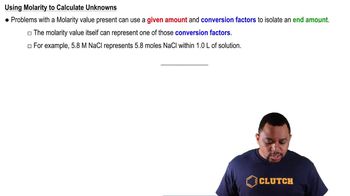
Molarity is a measure of concentration defined as the number of moles of solute per liter of solution. It is expressed in units of moles per liter (mol/L). To calculate molarity, one must know the amount of solute in moles and the total volume of the solution in liters.
추천 영상:

Conversion of Volume Units

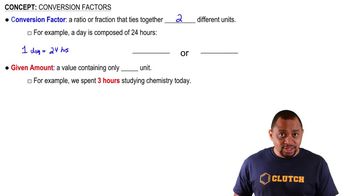
In chemistry, it is often necessary to convert volume measurements to liters when calculating molarity. Since 1 liter equals 1000 milliliters, to convert milliliters to liters, one divides the volume in milliliters by 1000. This conversion is crucial for accurate molarity calculations.
추천 영상:
가이드 코스
01:56
Conversion Factors

Stoichiometry

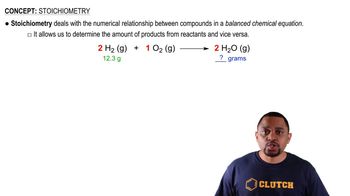
Stoichiometry involves the calculation of reactants and products in chemical reactions based on the balanced chemical equation. In this context, understanding stoichiometry helps in determining the amount of solute present in a solution, which is essential for calculating molarity.
추천 영상:
가이드 코스
01:16
Stoichiometry Concept