
교과서 질문
Using solubility guidelines, predict whether each of the following compounds is soluble or insoluble in water: (a) MgBr2 (b) NH4OH (c) Ni(CH3COO)2 (d) AgNO3 (e) FeCO3.
1363
views

 검증된 단계별 안내
 02:50
02:50
 01:39
01:39 01:11
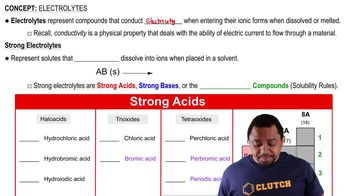
01:11Using solubility guidelines, predict whether each of the following compounds is soluble or insoluble in water: (a) MgBr2 (b) NH4OH (c) Ni(CH3COO)2 (d) AgNO3 (e) FeCO3.
Acetone, CH3COCH3, is a nonelectrolyte; hypochlorous acid, HClO, is a weak electrolyte; and ammonium chloride, NH4Cl, is a strong electrolyte. (a) What are the solutes present in aqueous solutions of each compound? What solute particles are present in an aqueous solution of HClO?
Acetone, CH3COCH3, is a nonelectrolyte; hypochlorous acid, HClO, is a weak electrolyte; and ammonium chloride, NH4Cl, is a strong electrolyte. (b) If 0.1 mol of each compound is dissolved in solution, which one contains 0.2 mol of solute particles, which contains 0.1 mol of solute particles, and which contains somewhere between 0.1 and 0.2 mol of solute particles?
Formic acid, HCOOH, is a weak electrolyte. Write the chemical equation for the ionization of HCOOH.
Acetone, CH3COCH3, is a nonelectrolyte; hypochlorous acid, HClO, is a weak electrolyte; and ammonium chloride, NH4Cl, is a strong electrolyte. (a) What are the solutes present in aqueous solutions of each compound? What solute particles are present in an aqueous solution of NH4Cl?
Predict whether each of the following compounds is soluble in water: (a) MgS (b) Cr(OH)3 (c) ZnCl2 (d) Pb3(PO4)2 (e) Sr(CH3COO)2.