
Pure acetic acid, known as glacial acetic acid, is a liquid with a density of 1.049 g/mL at 25 C. Calculate the molarity of a solution of acetic acid made by dissolving 20.00 mL of glacial acetic acid at 25 C in enough water to make 250.0 mL of solution.
Ch.4 - Reactions in Aqueous Solution
4장, 문제 76
Calicheamicin gamma-1, C55H74IN3O21S4, is one of the most potent antibiotics known: one molecule kills one bacterial cell. Describe how you would (carefully!) prepare 25.00 mL of an aqueous calicheamicin gamma-1 solution that could kill 1.0 * 108 bacteria, starting from a 5.00 * 10-9M stock solution of the antibiotic.
검증된 단계별 안내1
Determine the number of moles of calicheamicin gamma-1 needed to kill 1.0 \(\times\) 10^8 bacteria, knowing that one molecule kills one bacterial cell. Use Avogadro's number (6.022 \(\times\) 10^{23} molecules/mol) to convert the number of molecules to moles.
Calculate the volume of the stock solution required to obtain the moles of calicheamicin gamma-1 needed. Use the formula: \( C_1V_1 = C_2V_2 \), where \( C_1 \) is the concentration of the stock solution, \( V_1 \) is the volume of the stock solution needed, \( C_2 \) is the concentration of the desired solution, and \( V_2 \) is the volume of the desired solution.
Rearrange the formula to solve for \( V_1 \): \( V_1 = \frac{C_2V_2}{C_1} \). Substitute the known values: \( C_1 = 5.00 \times 10^{-9} \text{ M} \), \( V_2 = 25.00 \text{ mL} \), and \( C_2 \) is the concentration calculated from the moles needed.
Convert the volume \( V_1 \) from liters to milliliters if necessary, as the final preparation will be in milliliters.
Carefully measure \( V_1 \) mL of the stock solution using a pipette and dilute it with distilled water in a volumetric flask to a final volume of 25.00 mL to prepare the desired solution.

비슷한 문제에 대한 검증된 영상 답변:
이 영상 해법은 위 문제에 도움이 된다고 튜터들이 추천한 것입니다.
영상 길이:
2m주요 개념
질문에 올바르게 답하기 위해 반드시 이해해야 하는 핵심 개념들은 다음과 같습니다.
Molarity and Dilution
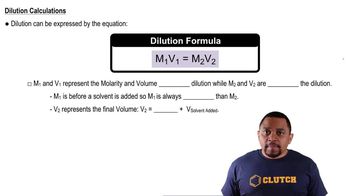
Molarity (M) is a measure of concentration defined as the number of moles of solute per liter of solution. To prepare a specific concentration from a stock solution, the dilution equation (C1V1 = C2V2) is used, where C1 and V1 are the concentration and volume of the stock solution, and C2 and V2 are the desired concentration and volume of the diluted solution. Understanding this concept is crucial for accurately preparing the required solution.
추천 영상:
가이드 코스
Dilution Equation
Bacterial Cell Count
To determine how much calicheamicin gamma-1 is needed to kill a specific number of bacteria, one must understand the relationship between the antibiotic's potency and the bacterial cell count. In this case, the problem states that one molecule of calicheamicin can kill one bacterial cell, so to kill 1.0 * 10^8 bacteria, you need 1.0 * 10^8 molecules of the antibiotic. This translates to calculating the required molarity based on Avogadro's number.
추천 영상:
가이드 코스
The Electrolytic Cell
Volume Calculation
Once the required concentration of the antibiotic solution is determined, the next step is to calculate the volume of the stock solution needed to achieve this concentration in the final volume of 25.00 mL. This involves using the dilution equation to find V1, which represents the volume of the stock solution to be diluted. Accurate volume measurement is essential for ensuring the solution's effectiveness in killing the targeted bacterial cells.
추천 영상:
가이드 코스
Constant-Volume Calorimetry
관련 실천
교과서 질문
4577
views
2
rank
교과서 질문
(b) If you dilute 10.0 mL of the stock solution to a final volume of 0.250 L, what will be the concentration of the diluted solution?
1106
views
교과서 질문
(a) How many milliliters of a stock solution of 6.0 M HNO3 would you have to use to prepare 110 mL of 0.500 M HNO3?
1358
views
1
rank
교과서 질문
medical lab is testing a new anticancer drug on cancer cells. The drug stock solution concentration is 1.5 * 10-9 M, and 1.00 mL of this solution will be delivered to a dish containing 2.0 * 105 cancer cells in 5.00 mL of aqueous fluid. What is the ratio of drug molecules to the number of cancer cells in the dish?
1409
views
