Ch.4 - Reactions in Aqueous Solution
Brown - Chemistry: The Central Science 14th Edition
Brown14th EditionChemistry: The Central ScienceISBN: 9780134414232당신이 사용하는 게 아니라요?교과서 변경
4장, 문제 102b

Citric acid, C6H8O7, is a triprotic acid. It occurs naturally in citrus fruits like lemons and has applications in food flavouring and preservatives. A solution containing an unknown concentration of the acid is titrated with KOH. It requires 23.20 mL of 0.500 M KOH solution to titrate all three acidic protons in 100.00 mL of the citric acid solution. Calculate the molarity of the citric acid solution.

검증된 단계별 안내
1
Identify the balanced chemical equation for the reaction: \[ \text{C}_6\text{H}_8\text{O}_7 + 3\text{KOH} \rightarrow \text{K}_3\text{C}_6\text{H}_5\text{O}_7 + 3\text{H}_2\text{O} \].
Determine the moles of KOH used in the titration: \[ \text{moles of KOH} = \text{Molarity of KOH} \times \text{Volume of KOH in liters} \].
Use the stoichiometry of the balanced equation to find the moles of citric acid: Since 3 moles of KOH react with 1 mole of citric acid, divide the moles of KOH by 3.
Calculate the molarity of the citric acid solution: \[ \text{Molarity of citric acid} = \frac{\text{moles of citric acid}}{\text{Volume of citric acid solution in liters}} \].
Convert the volume of the citric acid solution from milliliters to liters for the molarity calculation.

비슷한 문제에 대한 검증된 영상 답변:

이 영상 해법은 위 문제에 도움이 된다고 튜터들이 추천한 것입니다.
영상 길이:
3m

주요 개념

질문에 올바르게 답하기 위해 반드시 이해해야 하는 핵심 개념들은 다음과 같습니다.

Triprotic Acids

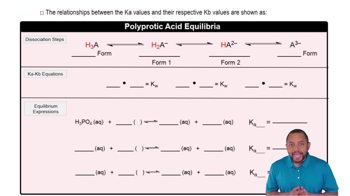
Triprotic acids, like citric acid, can donate three protons (H+) per molecule during a reaction. This characteristic affects their titration behavior, as each proton can react with a base, such as KOH, in a stepwise manner. Understanding the nature of triprotic acids is essential for calculating the total moles of acid present in a solution based on the volume and concentration of the titrant used.
추천 영상:
가이드 코스
6:47
Triprotic Acid Equilibrium

Titration

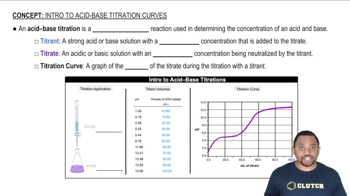
Titration is a quantitative analytical technique used to determine the concentration of a solute in a solution. In this case, KOH is used to neutralize citric acid, allowing for the calculation of the acid's molarity based on the volume of titrant required to reach the endpoint. The stoichiometry of the reaction between the acid and base is crucial for accurate calculations.
추천 영상:
가이드 코스
03:04
Acid-Base Titration

Molarity

Molarity is a measure of concentration defined as the number of moles of solute per liter of solution. It is expressed in moles per liter (M). To find the molarity of the citric acid solution, one must calculate the total moles of citric acid neutralized by the KOH and then divide by the volume of the acid solution in liters. This concept is fundamental in stoichiometric calculations in chemistry.
추천 영상:
관련 실천
교과서 질문

Suppose you have 3.00 g of powdered zinc metal, 3.00g of powdered silver metal and 500.0 mL of a 0.2 M copper(II) nitrate solution. (b) What is the net ionic equation that describes this reaction?

1
views

교과서 질문

Hard water contains Ca2+, Mg2+, and Fe2+, which interfere with the action of soap and leave an insoluble coating on the insides of containers and pipes when heated. Water softeners replace these ions with Na+. Keep in mind that charge balance must be maintained. (b) If the sodium is added to the water softener in the form of NaCl, how many grams of sodium chloride are needed?

843
views
교과서 질문

Citric acid, C6H8O7, is a triprotic acid. It occurs naturally in citrus fruits like lemons and has applications in food flavouring and preservatives. A solution containing an unknown concentration of the acid is titrated with KOH. It requires 23.20 mL of 0.500 M KOH solution to titrate all three acidic protons in 100.00 mL of the citric acid solution. Write a balanced net ionic equation for the neutralization reaction.

759
views
교과서 질문

Suppose you have 3.00 g of powdered zinc metal, 3.00g of powdered silver metal and 500.0 mL of a 0.2 M copper(II) nitrate solution. (a) Which metal will react with the copper(II) nitrate solution?

330
views
교과서 질문
(c) If 18.65 mL of the caesium hydroxide solution was needed to neutralize a 42.3 mL aliquot of the hydroiodic acid solution, what is the concentration (molarity) of the acid?
492
views
교과서 질문

Hard water contains Ca2+, Mg2+, and Fe2+, which interfere with the action of soap and leave an insoluble coating on the insides of containers and pipes when heated. Water softeners replace these ions with Na+. Keep in mind that charge balance must be maintained. (a) If 1500 L of hard water contains 0.020 M Ca2+ and 0.0040 M Mg2+, how many moles of Na+ are needed to replace these ions?

1566
views