Ch.4 - Reactions in Aqueous Solution
Brown - Chemistry: The Central Science 14th Edition
Brown14th EditionChemistry: The Central ScienceISBN: 9780134414232당신이 사용하는 게 아니라요?교과서 변경
4장, 문제 71d

Ignoring protolysis reactions, indicate the concentration of each ion or molecule present in the following solutions: (d) a mixture of 45.0 mL of 0.272 M NaCl and 65.0 mL of 0.0247 M (NH4)2CO3. Assume that the volumes are additive.

검증된 단계별 안내
1
Calculate the total volume of the solution by adding the volumes of the NaCl and (NH4)2CO3 solutions. This is done by adding 45.0 mL and 65.0 mL.
Calculate the moles of NaCl initially present using its concentration and the volume of the NaCl solution. Use the formula: moles = concentration (M) imes volume (L).
Calculate the moles of (NH4)2CO3 initially present using its concentration and the volume of the (NH4)2CO3 solution. Use the same formula as in step 2.
Determine the concentration of each ion in the final solution. For NaCl, which dissociates into Na+ and Cl-, the concentration of each ion is equal to the total moles of NaCl divided by the total volume of the solution. For (NH4)2CO3, which dissociates into 2NH4+ and CO32-, the concentration of NH4+ is twice the moles of (NH4)2CO3 divided by the total volume, and the concentration of CO32- is equal to the moles of (NH4)2CO3 divided by the total volume.
Summarize the concentrations of Na+, Cl-, NH4+, and CO32- in the final solution.

비슷한 문제에 대한 검증된 영상 답변:

이 영상 해법은 위 문제에 도움이 된다고 튜터들이 추천한 것입니다.
영상 길이:
3m
도움이 되었나요?

주요 개념

질문에 올바르게 답하기 위해 반드시 이해해야 하는 핵심 개념들은 다음과 같습니다.

Concentration and Molarity

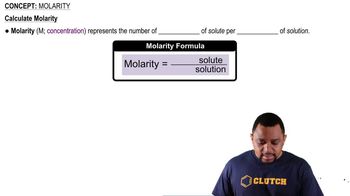
Concentration refers to the amount of solute present in a given volume of solution, commonly expressed in molarity (M), which is moles of solute per liter of solution. Understanding how to calculate molarity is essential for determining the concentration of ions or molecules in a mixture.
추천 영상:
가이드 코스
00:53
Molarity Concept

Dilution and Mixing Solutions

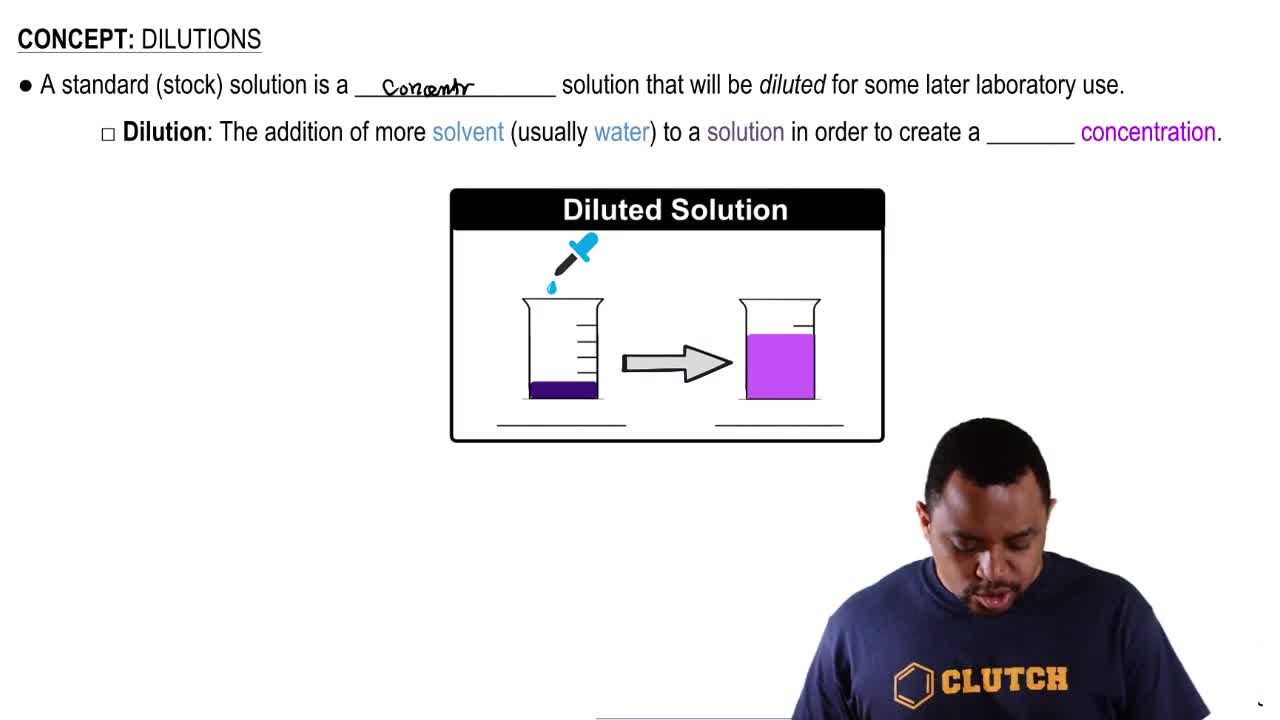
When two solutions are mixed, the total volume increases, and the concentrations of the solutes change. The final concentration can be calculated using the formula C1V1 + C2V2 = CfinalVfinal, where C is concentration and V is volume. This principle is crucial for accurately determining the concentrations of ions in the resulting solution.
추천 영상:
가이드 코스
01:03
Solution Dilution Process

Ionic Dissociation

Ionic compounds, such as NaCl, dissociate into their constituent ions when dissolved in water. For example, NaCl dissociates into Na⁺ and Cl⁻ ions. Understanding how different compounds dissociate is vital for calculating the concentrations of individual ions in a mixed solution.
추천 영상: