Ch.4 - Reactions in Aqueous Solution
Brown - Chemistry: The Central Science 14th Edition
Brown14th EditionChemistry: The Central ScienceISBN: 9780134414232당신이 사용하는 게 아니라요?교과서 변경
4장, 문제 115 b

Potassium superoxide, KO2, is often used in oxygen masks (such as those used by firefighters) because KO2 reacts with CO2 to release molecular oxygen. Experiments indicate that 2 mol of KO2(s) react with each mole of CO2(g). (b) Indicate the oxidation number for each atom involved in the reaction in part (a). What elements are being oxidized and reduced?

검증된 단계별 안내
1
Identify the chemical reaction: 4 KO_2 + 2 CO_2 \(\rightarrow\) 2 K_2CO_3 + 3 O_2.
Determine the oxidation number of each element in the reactants: K in KO_2 is +1, O in KO_2 is -1/2, C in CO_2 is +4, and O in CO_2 is -2.
Determine the oxidation number of each element in the products: K in K_2CO_3 is +1, C in K_2CO_3 is +4, O in K_2CO_3 is -2, and O_2 is 0.
Compare the oxidation numbers of each element in the reactants and products to identify changes: O in KO_2 changes from -1/2 to 0, indicating oxidation, and O in CO_2 changes from -2 to -2, indicating no change.
Conclude which elements are oxidized and reduced: Oxygen in KO_2 is oxidized, and no element is reduced as there is no decrease in oxidation number.

비슷한 문제에 대한 검증된 영상 답변:

이 영상 해법은 위 문제에 도움이 된다고 튜터들이 추천한 것입니다.
영상 길이:
1m
도움이 되었나요?

주요 개념

질문에 올바르게 답하기 위해 반드시 이해해야 하는 핵심 개념들은 다음과 같습니다.

Oxidation States

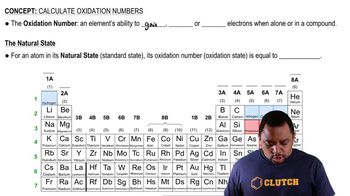
Oxidation states, or oxidation numbers, are a way to keep track of electrons in chemical reactions. They indicate the degree of oxidation of an atom in a compound, helping to identify which atoms are losing or gaining electrons. In the context of the reaction involving KO2 and CO2, determining the oxidation states of potassium, oxygen, and carbon is essential for identifying the elements that are oxidized and reduced.
추천 영상:
가이드 코스
02:42
Oxidation Numbers

Redox Reactions

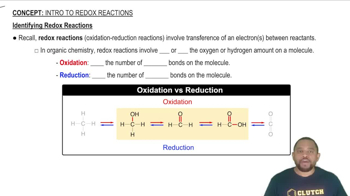
Redox reactions, short for reduction-oxidation reactions, involve the transfer of electrons between two species. In these reactions, one species is oxidized (loses electrons) while another is reduced (gains electrons). Understanding the principles of redox reactions is crucial for analyzing the reaction between KO2 and CO2, as it allows us to determine which elements undergo oxidation and reduction.
추천 영상:
가이드 코스
03:12
Identifying Redox Reactions

Stoichiometry

Stoichiometry is the calculation of reactants and products in chemical reactions based on the conservation of mass. It involves using balanced chemical equations to determine the proportions of substances involved. In the case of KO2 reacting with CO2, stoichiometry helps to quantify the amounts of each reactant and product, which is important for understanding the overall reaction and its implications in practical applications like oxygen masks.
추천 영상:
가이드 코스
01:16
Stoichiometry Concept
관련 실천
교과서 질문
Chlorine dioxide gas 1ClO22 is used as a commercial bleaching agent. It bleaches materials by oxidizing them. In the course of these reactions, the ClO2 is itself reduced. (b) Why do you think that ClO2 is reduced so readily?

559
views

교과서 질문

Federal regulations set an upper limit of 50 parts per million (ppm) of NH3 in the air in a work environment [that is, 50 molecules of NH3(g) for every million molecules in the air]. Air from a manufacturing operation was drawn through a solution containing 1.00⨉102 mL of 0.0105 M HCl. The NH3 reacts with HCl according to: NH3(aq) + HCl(aq) → NH4Cl(aq). After drawing air through the acid solution for 10.0 min at a rate of 10.0 L/min, the acid was titrated. The remaining acid needed 13.1 mL of 0.0588 M NaOH to reach the equivalence point. (a) How many grams of NH3 were drawn into the acid solution?

448
views
교과서 질문

Federal regulations set an upper limit of 50 parts per million (ppm) of NH3 in the air in a work environment [that is, 50 molecules of NH3(g) for every million molecules in the air]. Air from a manufacturing operation was drawn through a solution containing 1.00⨉102 mL of 0.0105 M HCl. The NH3 reacts with HCl according to: NH3(aq) + HCl(aq) → NH4Cl(aq). After drawing air through the acid solution for 10.0 min at a rate of 10.0 L/min, the acid was titrated. The remaining acid needed 13.1 mL of 0.0588 M NaOH to reach the equivalence point. (b) How many ppm of NH3 were in the air? (Air has a density of 1.20 g/L and an average molar mass of 29.0 g/mol under the conditions of the experiment.)

467
views