
Ch.4 - Reactions in Aqueous Solution
Brown - Chemistry: The Central Science 14th Edition
Brown14th EditionChemistry: The Central ScienceISBN: 9780134414232당신이 사용하는 게 아니라요?교과서 변경
4장, 문제 84

The distinctive odor of vinegar is due to acetic acid, CH3COOH, which reacts with sodium hydroxide according to: CH3COOH1aq2 + NaOH1aq2¡ H2O1l2 + NaCH3COO1aq2 If 3.45 mL of vinegar needs 42.5 mL of 0.115 M NaOH to reach the equivalence point in a titration, how many grams of acetic acid are in a 1.00-qt sample of this vinegar?

검증된 단계별 안내
1
Step 1: First, we need to convert the volume of NaOH from mL to L. We know that 1 L = 1000 mL. So, 42.5 mL = 42.5/1000 = 0.0425 L.
Step 2: Next, we can calculate the moles of NaOH using the molarity formula. Molarity (M) = moles/volume(L). So, moles of NaOH = Molarity * Volume = 0.115 M * 0.0425 L.
Step 3: From the balanced chemical equation, we can see that the reaction between acetic acid and sodium hydroxide is a 1:1 ratio. Therefore, the moles of acetic acid will be equal to the moles of NaOH.
Step 4: Now, we can calculate the mass of acetic acid using the formula: mass = moles * molar mass. The molar mass of acetic acid (CH3COOH) is approximately 60.052 g/mol.
Step 5: Finally, we need to find out how many grams of acetic acid are in a 1.00-qt sample of vinegar. We know that 1 qt = 946.353 mL. So, if 3.45 mL of vinegar contains the mass of acetic acid we calculated, then 1.00 qt of vinegar will contain = (mass of acetic acid in 3.45 mL) * (946.353/3.45).

비슷한 문제에 대한 검증된 영상 답변:

이 영상 해법은 위 문제에 도움이 된다고 튜터들이 추천한 것입니다.
영상 길이:
3m

주요 개념

질문에 올바르게 답하기 위해 반드시 이해해야 하는 핵심 개념들은 다음과 같습니다.

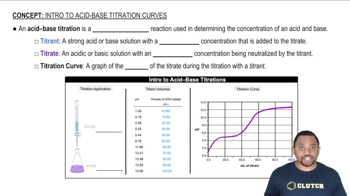
Titration

Titration is a quantitative analytical technique used to determine the concentration of a solute in a solution. It involves the gradual addition of a titrant, a solution of known concentration, to a sample until the reaction reaches the equivalence point, where the amount of titrant equals the amount of substance in the sample. This method is commonly used in acid-base reactions to find the concentration of acids or bases.
추천 영상:
가이드 코스
03:04
Acid-Base Titration

Molarity

Molarity is a measure of concentration defined as the number of moles of solute per liter of solution. It is expressed in moles per liter (M) and is crucial for calculations in titration, as it allows for the determination of how much of a reactant is needed to react with a given amount of another substance. Understanding molarity is essential for converting volumes and concentrations during titration calculations.
추천 영상:

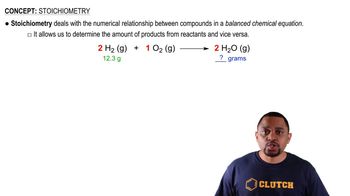
Stoichiometry

Stoichiometry is the branch of chemistry that deals with the relationships between the quantities of reactants and products in a chemical reaction. It is based on the balanced chemical equation, which provides the mole ratios needed to calculate the amounts of substances involved. In the context of the titration question, stoichiometry is used to relate the volume and concentration of sodium hydroxide to the amount of acetic acid present in the vinegar.
추천 영상:
가이드 코스
01:16
Stoichiometry Concept
관련 실천
교과서 질문

A 4.36-g sample of an unknown alkali metal hydroxide is dissolved in 100.0 mL of water. An acid–base indicator is added, and the resulting solution is titrated with 2.50 M HCl(aq) solution. The indicator changes color, signaling that the equivalence point has been reached, after 17.0 mL of the hydrochloric acid solution has been added. (b) What is the identity of the alkali metal cation: Li+, Na+, K+, Rb+, or Cs+?

455
views
교과서 질문

(d) If 42.7 mL of 0.208 M HCl solution is needed to neutralize a solution of Ca(OH)2, how many grams of Ca(OH)2 must be in the solution?

교과서 질문

(c) If 55.8 mL of a BaCl2 solution is needed to precipitate all the sulfate ion in a 752-mg sample of Na2SO4, what is the molarity of the BaCl2 solution?

758
views
교과서 질문

A 4.36-g sample of an unknown alkali metal hydroxide is dissolved in 100.0 mL of water. An acid–base indicator is added, and the resulting solution is titrated with 2.50 M HCl(aq) solution. The indicator changes color, signaling that the equivalence point has been reached, after 17.0 mL of the hydrochloric acid solution has been added. (a) What is the molar mass of the metal hydroxide?

1602
views
교과서 질문

An 8.65-g sample of an unknown group 2 metal hydroxide is dissolved in 85.0 mL of water. An acid–base indicator is added and the resulting solution is titrated with 2.50 M HCl(aq) solution. The indicator changes color, signaling that the equivalence point has been reached, after 56.9 mL of the hydrochloric acid solution has been added. (a) What is the molar mass of the metal hydroxide? (b) What is the identity of the metal cation: Ca2+, Sr2+, or Ba2+?

1120
views