Ch.4 - Reactions in Aqueous Solution
Brown - Chemistry: The Central Science 14th Edition
Brown14th EditionChemistry: The Central ScienceISBN: 9780134414232당신이 사용하는 게 아니라요?교과서 변경
4장, 문제 9

What kind of reaction is the 'water-splitting' reaction? H2O(l)¡H2(g) + ½ O2(g) (a) an acid-base reaction (b) a metathesis reaction (c) a redox reaction (d) a precipitation reaction

검증된 단계별 안내
1
Identify the type of reaction by analyzing the reactants and products.
Recognize that the reaction involves the decomposition of water into hydrogen and oxygen gases.
Understand that in this reaction, water (H2O) is split into hydrogen (H2) and oxygen (O2) molecules.
Note that the oxidation states of elements change during the reaction: hydrogen goes from +1 in H2O to 0 in H2, and oxygen goes from -2 in H2O to 0 in O2.
Conclude that the change in oxidation states indicates that this is a redox (reduction-oxidation) reaction.

비슷한 문제에 대한 검증된 영상 답변:

이 영상 해법은 위 문제에 도움이 된다고 튜터들이 추천한 것입니다.
영상 길이:
1m

주요 개념

질문에 올바르게 답하기 위해 반드시 이해해야 하는 핵심 개념들은 다음과 같습니다.

Redox Reactions

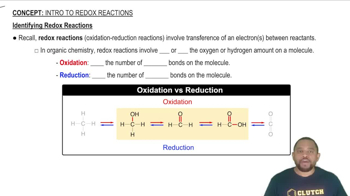
Redox reactions, or reduction-oxidation reactions, involve the transfer of electrons between substances. In these reactions, one species is oxidized (loses electrons) while another is reduced (gains electrons). The water-splitting reaction demonstrates this as water (H2O) is split into hydrogen gas (H2) and oxygen gas (O2), with oxygen being oxidized and hydrogen being reduced.
추천 영상:
가이드 코스
03:12
Identifying Redox Reactions

Oxidation States

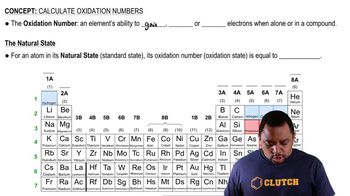
Oxidation states are a way to keep track of electron transfer in redox reactions. Each atom in a molecule is assigned an oxidation state based on its electron count relative to its elemental form. In the water-splitting reaction, the oxidation state of oxygen increases from -2 in H2O to 0 in O2, indicating that it has been oxidized, while hydrogen's oxidation state decreases from +1 to 0, indicating reduction.
추천 영상:
가이드 코스
02:42
Oxidation Numbers

Electrolysis

Electrolysis is a process that uses electrical energy to drive a non-spontaneous chemical reaction, such as the water-splitting reaction. In this context, an electric current is applied to water, causing it to decompose into hydrogen and oxygen gases. This process is fundamental in various applications, including hydrogen production for fuel cells and energy storage.
추천 영상:
가이드 코스
01:21
The Electrolytic Cell